
Welcome to the Brachiopod subsite on Invertebrate Paleontology!
Please enter a genera name to retrieve more information.
Anastrophia
Classification
Phylum:
Brachiopoda
Subphylum:
Rhynchonelliformea
Class:
Rhynchonellata
Order:
Pentamerida
Suborder:
Syntrophiidina
Superfamily:
Camerelloidea
Family:
Parastrophinidae
Formal Genus Name and Reference:
Anastrophia Hall, 1867a, p. 162-163, nov. pro Brachymerus Shaler, 1865, p. 69, non De JEAN, 1834
Type Species:
Pentamerus verneuili HALL, 1857a, p. 104, OD
Images
(Click to enlarge in a new window)
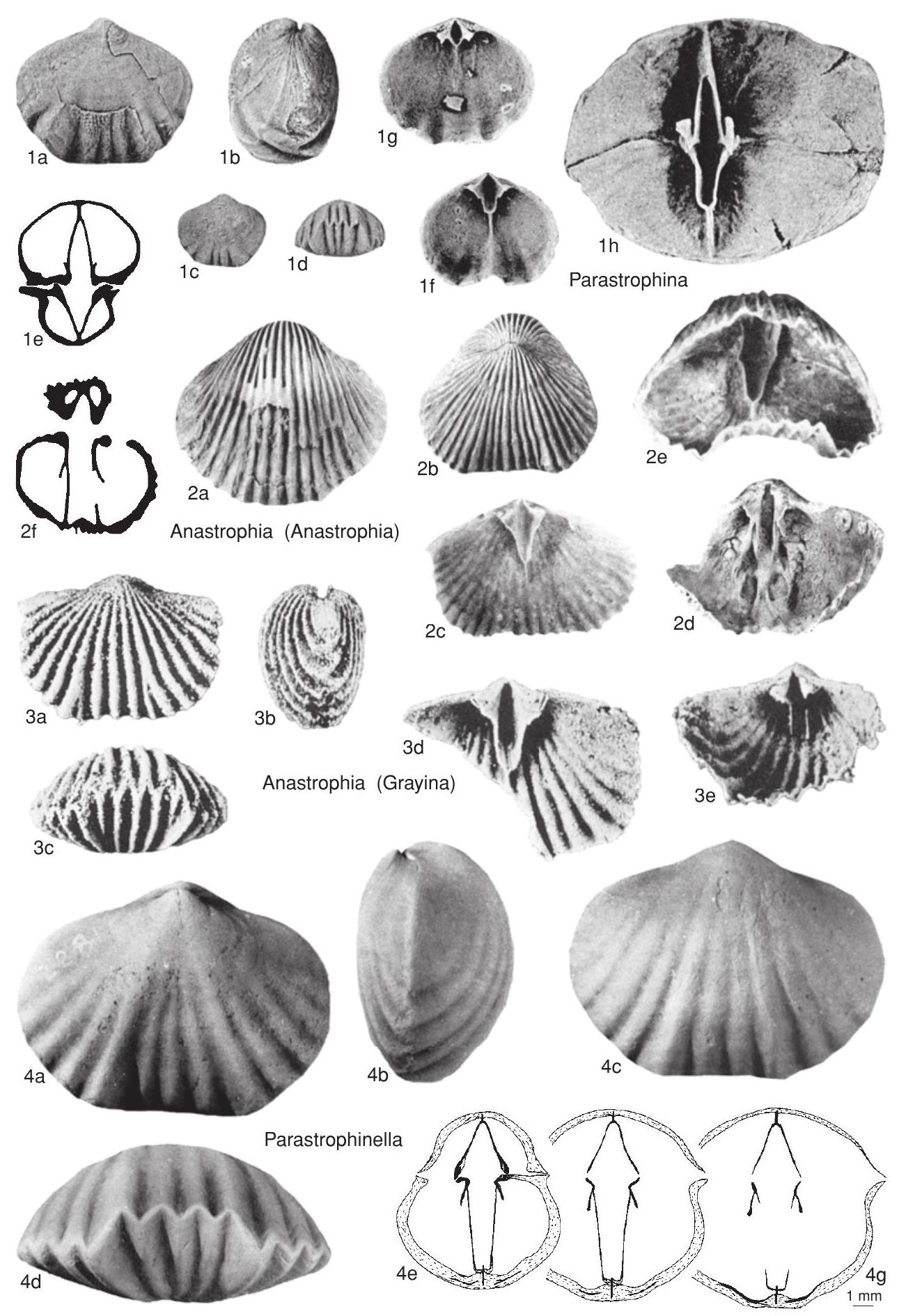 Fig. 640, 2a–f. *A. (A.) verneuili (HALL), Lochkovian, lower Helderberg Group, New York, USA; a, ventral valve exterior; b, dorsal valve exterior, × 1 (Shimer & Shrock, 1944); c, ventral valve interior; d, dorsal valve interior; e, articulated valves, interior view of valve posteriors, ventral below, × 1.5 (Schuchert & Cooper, 1932); f, section through articulated valves, dorsal valve below, showing alate plates, ×2 (St. Joseph, 1941).
Synonyms
Savageina
Geographic Distribution
USA, Canada, Britain, Europe, Ukraine, Russia, Kazakhstan, China, Mongolia, Indochina, Australia, Venezuela
Age Range
Beginning Stage in Treatise Usage:
Silurian (Wenlock)
Beginning International Stage:
Sheinwoodian
Fraction Up In Beginning Stage:
0
Beginning Date:
432.93
Ending Stage in Treatise Usage:
Lower Devonian (Pragian)
Ending International Stage:
Pragian
Fraction Up In Ending Stage:
100
Ending Date:
410.51
Description
Strong costae cover entire valve surface, minimal bifurcation anteriorly, exaggerated dorsibiconvexity, uniplication broad and strong, hinge line astrophic, less commonly strophic, of variable width, teeth strong, wide, long sessile spondylium duplex supported anteriorly only by low, narrow median septum that extends anterior to spondylium, less commonly supported along entire length by relatively high duplex median septum, short outer hinge plates, slightly splayed out, that extend into long, subparallel inner hinge plates anterior to long, bladelike crura, median septum and septalium absent, internal features often thickened in older individuals, anterior ends of hinge plates may converge, simulating sessile septalium, not unlike Porambonites, alate plates vary in length, adductor muscle field quadrilobate, may have weak callosities.
References
Museum or Author Information
Classification
Phylum:
Brachiopoda
Subphylum:
Rhynchonelliformea
Class:
Rhynchonellata
Order:
Pentamerida
Suborder:
Syntrophiidina
Superfamily:
Camerelloidea
Family:
Parastrophinidae
Formal Genus Name and Reference:
Anastrophia Hall, 1867a, p. 162-163, nov. pro Brachymerus Shaler, 1865, p. 69, non De JEAN, 1834
Type Species:
Pentamerus verneuili HALL, 1857a, p. 104, OD
Images
(Click to enlarge in a new window)
Fig. 640, 2a–f. *A. (A.) verneuili (HALL), Lochkovian, lower Helderberg Group, New York, USA; a, ventral valve exterior; b, dorsal valve exterior, × 1 (Shimer & Shrock, 1944); c, ventral valve interior; d, dorsal valve interior; e, articulated valves, interior view of valve posteriors, ventral below, × 1.5 (Schuchert & Cooper, 1932); f, section through articulated valves, dorsal valve below, showing alate plates, ×2 (St. Joseph, 1941).
Synonyms
Savageina
Geographic Distribution
USA, Canada, Britain, Europe, Ukraine, Russia, Kazakhstan, China, Mongolia, Indochina, Australia, Venezuela
Age Range
Beginning Stage in Treatise Usage:
Silurian (Wenlock)
Beginning International Stage:
Sheinwoodian
Fraction Up In Beginning Stage:
0
Beginning Date:
432.93
Ending Stage in Treatise Usage:
Lower Devonian (Pragian)
Ending International Stage:
Pragian
Fraction Up In Ending Stage:
100
Ending Date:
410.51
Description
Strong costae cover entire valve surface, minimal bifurcation anteriorly, exaggerated dorsibiconvexity, uniplication broad and strong, hinge line astrophic, less commonly strophic, of variable width, teeth strong, wide, long sessile spondylium duplex supported anteriorly only by low, narrow median septum that extends anterior to spondylium, less commonly supported along entire length by relatively high duplex median septum, short outer hinge plates, slightly splayed out, that extend into long, subparallel inner hinge plates anterior to long, bladelike crura, median septum and septalium absent, internal features often thickened in older individuals, anterior ends of hinge plates may converge, simulating sessile septalium, not unlike Porambonites, alate plates vary in length, adductor muscle field quadrilobate, may have weak callosities.