
Welcome to the Brachiopod subsite on Invertebrate Paleontology!
Please enter a genera name to retrieve more information.
Athyrisina
Classification
Phylum:
Brachiopoda
Subphylum:
Rhynchonelliformea
Class:
Rhynchonellata
Order:
Athyridida
Suborder:
Athyrididina
Superfamily:
Athyridoidea
Family:
Athyrididae
Subfamily:
Athyrisininae
Formal Genus Name and Reference:
Athyrisina Hayasaka in Yabe & Hayasaka, 1920, p. 176, emend., Rong & OTHERS, 2004, p. 827
Type Species:
* A. squamosa, OD
Images
(Click to enlarge in a new window)
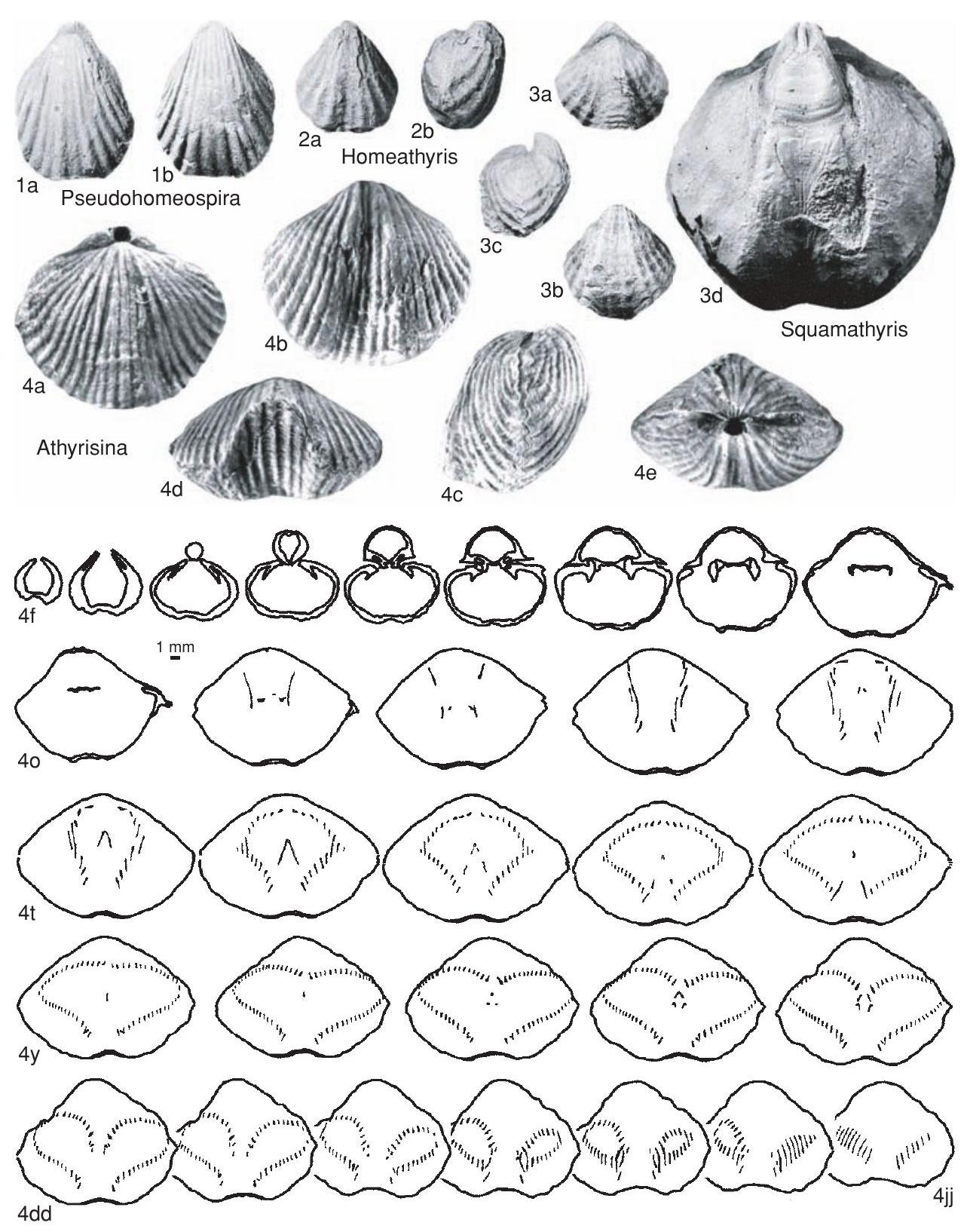
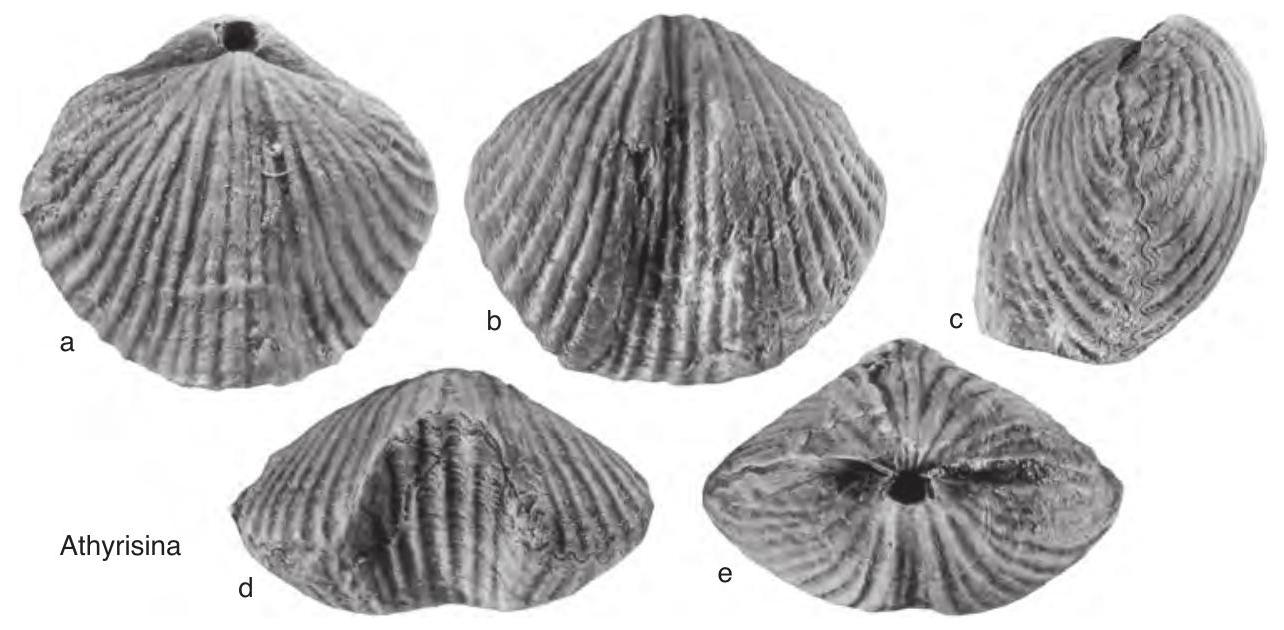 F ig . 1833a–e. *A. squamosa; neotype, dorsal, ventral, lateral, anterior, and posterior views, Yangmaba Formation, upper Emsian, Heitupo, Wenchuan County, northern Sichuan Province, NIGP 134224, × 1.5 (Rong & others, 2004).
Synonyms
Plectospirifer, Plectospirifer, Kwangsiella, Pseudoathyrisina, Athyrisinopsis
Geographic Distribution
southern China (northern Sichuan, southeastern Guizhou, eastern Yunnan, Guangxi), Qinling region (western and eastern Shaanxi, southeastern Gansu, northernmost Sichuan), western Sichuan (Ganzi Block), northern Vietnam
Age Range
Beginning Stage in Treatise Usage:
Lower Devonian (upper Pragian)
Beginning International Stage:
Pragian
Fraction Up In Beginning Stage:
50
Beginning Date:
411.46
Ending Stage in Treatise Usage:
Middle Devonian (Givetian)
Ending International Stage:
Givetian
Fraction Up In Ending Stage:
100
Ending Date:
378.9
Description
Small to large shells with rounded subpentagonal to transversely elliptical dorsal outline, with short to relatively long hinge line, ventribiconvex lateral profile; ventral sulcus and dorsal fold usually well developed; pauciplicate to costellate, radial elements may bifurcate; growth lamellae numerous, commonly well developed and regularly spaced; dental plates thin, short, lateral apical cavities very narrow; cardinal plate perforated apically by minute foramen, spiralia with 10 to 18 whorls. [Distinguished from other Athyrisininae by having 3 or more ribs in the sulcus, of the same width as those on the flanks. Radial elements are more numerous in Athyrisina than in Bruntosina rOng & others and Parathyrisina wang, and the ribs bounding the sulcus are similar to those on the flanks and sulcus.]
References
Museum or Author Information
Classification
Phylum:
Brachiopoda
Subphylum:
Rhynchonelliformea
Class:
Rhynchonellata
Order:
Athyridida
Suborder:
Athyrididina
Superfamily:
Athyridoidea
Family:
Athyrididae
Subfamily:
Athyrisininae
Formal Genus Name and Reference:
Athyrisina Hayasaka in Yabe & Hayasaka, 1920, p. 176, emend., Rong & OTHERS, 2004, p. 827
Type Species:
* A. squamosa, OD
Images
(Click to enlarge in a new window)
F ig . 1833a–e. *A. squamosa; neotype, dorsal, ventral, lateral, anterior, and posterior views, Yangmaba Formation, upper Emsian, Heitupo, Wenchuan County, northern Sichuan Province, NIGP 134224, × 1.5 (Rong & others, 2004).
Synonyms
Plectospirifer, Plectospirifer, Kwangsiella, Pseudoathyrisina, Athyrisinopsis
Geographic Distribution
southern China (northern Sichuan, southeastern Guizhou, eastern Yunnan, Guangxi), Qinling region (western and eastern Shaanxi, southeastern Gansu, northernmost Sichuan), western Sichuan (Ganzi Block), northern Vietnam
Age Range
Beginning Stage in Treatise Usage:
Lower Devonian (upper Pragian)
Beginning International Stage:
Pragian
Fraction Up In Beginning Stage:
50
Beginning Date:
411.46
Ending Stage in Treatise Usage:
Middle Devonian (Givetian)
Ending International Stage:
Givetian
Fraction Up In Ending Stage:
100
Ending Date:
378.9
Description
Small to large shells with rounded subpentagonal to transversely elliptical dorsal outline, with short to relatively long hinge line, ventribiconvex lateral profile; ventral sulcus and dorsal fold usually well developed; pauciplicate to costellate, radial elements may bifurcate; growth lamellae numerous, commonly well developed and regularly spaced; dental plates thin, short, lateral apical cavities very narrow; cardinal plate perforated apically by minute foramen, spiralia with 10 to 18 whorls. [Distinguished from other Athyrisininae by having 3 or more ribs in the sulcus, of the same width as those on the flanks. Radial elements are more numerous in Athyrisina than in Bruntosina rOng & others and Parathyrisina wang, and the ribs bounding the sulcus are similar to those on the flanks and sulcus.]