
Welcome to the Brachiopod subsite on Invertebrate Paleontology!
Please enter a genera name to retrieve more information.

Atrypina
Classification
Phylum:
Brachiopoda
Subphylum:
Rhynchonelliformea
Class:
Rhynchonellata
Order:
Atrypida
Suborder:
Atrypidina
Superfamily:
Atrypoidea
Family:
Atrypinidae
Subfamily:
Atrypininae
Formal Genus Name and Reference:
Atrypina Hall in Hall & CLARKE, 1893, p. 161
Type Species:
Leptocoelia imbricata Hall, 1859b, p. 246, OD, vid. HALL, 1894, p. 815
Images
(Click to enlarge in a new window)
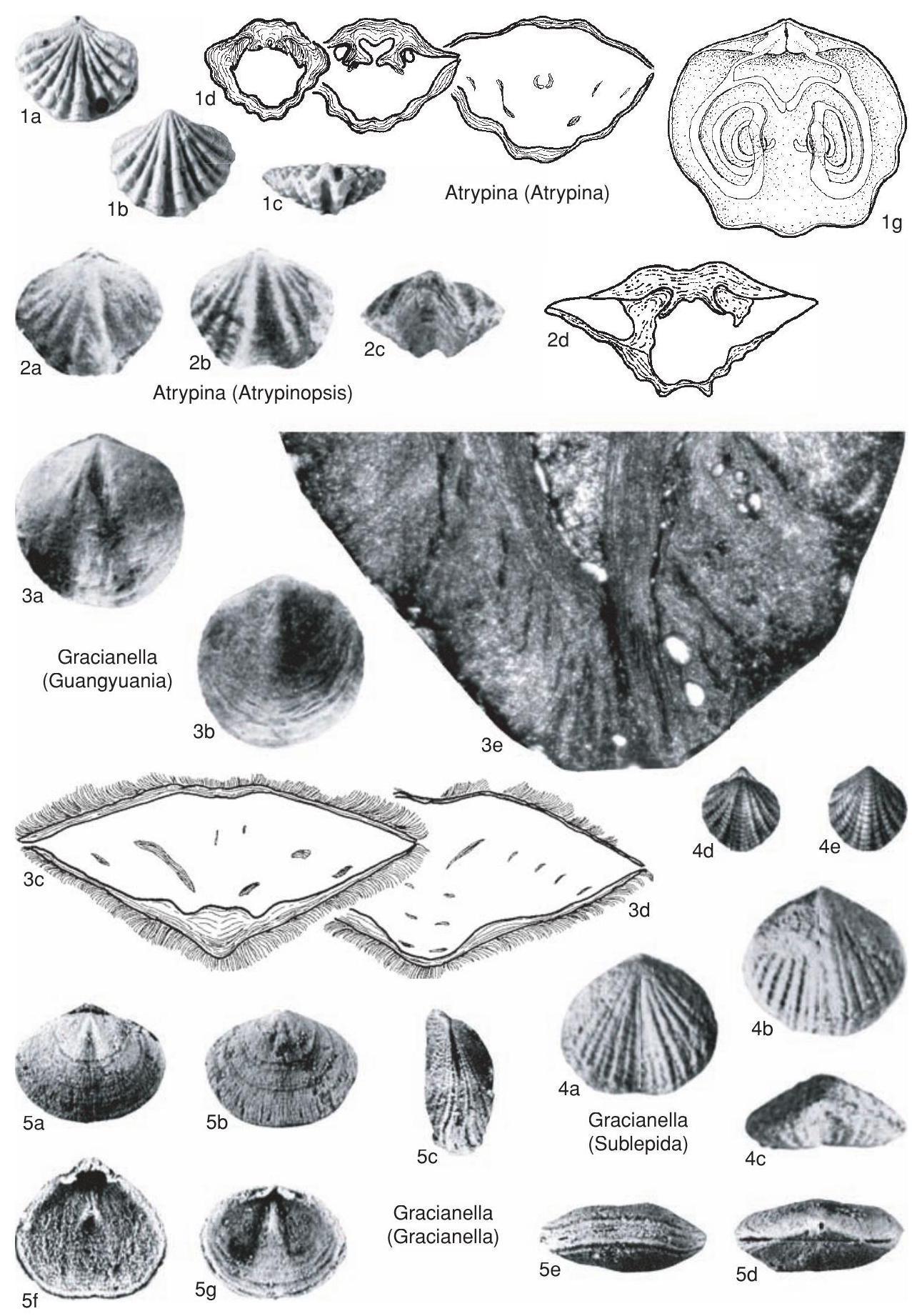 Fig. 963, 1a–c. *A. (A.) imbricata (HALL), lectotype, Emsian, New York, USA; dorsal, ventral, and anterior views, ×2 (new).——Fig. 963,1d–g. A. (A.) sp. cf. A. (A.) barrandii, Wenlock, United Kingdom; serial sections showing hinge plate, jugal processes, and reconstruction of brachidia, ×5 (new).
Synonyms
Geographic Distribution
North America, Eurasia
Age Range
Beginning Stage in Treatise Usage:
Upper Ordovician (upper Ashgill)
Beginning International Stage:
Hirnantian
Fraction Up In Beginning Stage:
0
Beginning Date:
445.21
Ending Stage in Treatise Usage:
Lower Devonian (Emsian)
Ending International Stage:
Emsian
Fraction Up In Ending Stage:
100
Ending Date:
394.3
Description
Small, suboval to subquadrate, planoconvex to subconcavoconvex to ventribiconvex, short hinge, minute orthocline to anacline area, beak small, projecting, apical foramen flanked by small triangular deltidial plates, relatively few, coarse expanding ribs, rarely bifurcating or intercalated, with strong ventral midrib pair, sulcus usually lined by strong dorsal midrib, anterior concentric growth lamellae very short or absent, apically lacking or missing in small shells, may have strong concentric ridges, commissure weakly sulcate to rectimarginate to weakly plicate. [Distinct from Gracianella by its stronger ribs, strong plicate commissure, roofed-over cardinal pit and fused hinge plate, externally by small size, very coarse ribs.]
References
Museum or Author Information
Classification
Phylum:
Brachiopoda
Subphylum:
Rhynchonelliformea
Class:
Rhynchonellata
Order:
Atrypida
Suborder:
Atrypidina
Superfamily:
Atrypoidea
Family:
Atrypinidae
Subfamily:
Atrypininae
Formal Genus Name and Reference:
Atrypina Hall in Hall & CLARKE, 1893, p. 161
Type Species:
Leptocoelia imbricata Hall, 1859b, p. 246, OD, vid. HALL, 1894, p. 815
Images
(Click to enlarge in a new window)
Fig. 963, 1a–c. *A. (A.) imbricata (HALL), lectotype, Emsian, New York, USA; dorsal, ventral, and anterior views, ×2 (new).——Fig. 963,1d–g. A. (A.) sp. cf. A. (A.) barrandii, Wenlock, United Kingdom; serial sections showing hinge plate, jugal processes, and reconstruction of brachidia, ×5 (new).
Synonyms
Geographic Distribution
North America, Eurasia
Age Range
Beginning Stage in Treatise Usage:
Upper Ordovician (upper Ashgill)
Beginning International Stage:
Hirnantian
Fraction Up In Beginning Stage:
0
Beginning Date:
445.21
Ending Stage in Treatise Usage:
Lower Devonian (Emsian)
Ending International Stage:
Emsian
Fraction Up In Ending Stage:
100
Ending Date:
394.3
Description
Small, suboval to subquadrate, planoconvex to subconcavoconvex to ventribiconvex, short hinge, minute orthocline to anacline area, beak small, projecting, apical foramen flanked by small triangular deltidial plates, relatively few, coarse expanding ribs, rarely bifurcating or intercalated, with strong ventral midrib pair, sulcus usually lined by strong dorsal midrib, anterior concentric growth lamellae very short or absent, apically lacking or missing in small shells, may have strong concentric ridges, commissure weakly sulcate to rectimarginate to weakly plicate. [Distinct from Gracianella by its stronger ribs, strong plicate commissure, roofed-over cardinal pit and fused hinge plate, externally by small size, very coarse ribs.]