
Welcome to the Brachiopod subsite on Invertebrate Paleontology!
Please enter a genera name to retrieve more information.
Costatumulus
Classification
Phylum:
Brachiopoda
Subphylum:
Rhynchonelliformea
Class:
Strophomenata
Order:
Productida
Suborder:
Productidina
Superfamily:
Linoproductoidea
Family:
Monticuliferidae
Subfamily:
Auriculispininae (Tribe Auriculispinini)
Formal Genus Name and Reference:
Costatumulus Waterhouse in Waterhouse & Briggs, 1986, p. 58
Type Species:
Auriculispina tumidus Waterhouse, Briggs, & PARFREY, 1983, p. 133, OD
Images
(Click to enlarge in a new window)
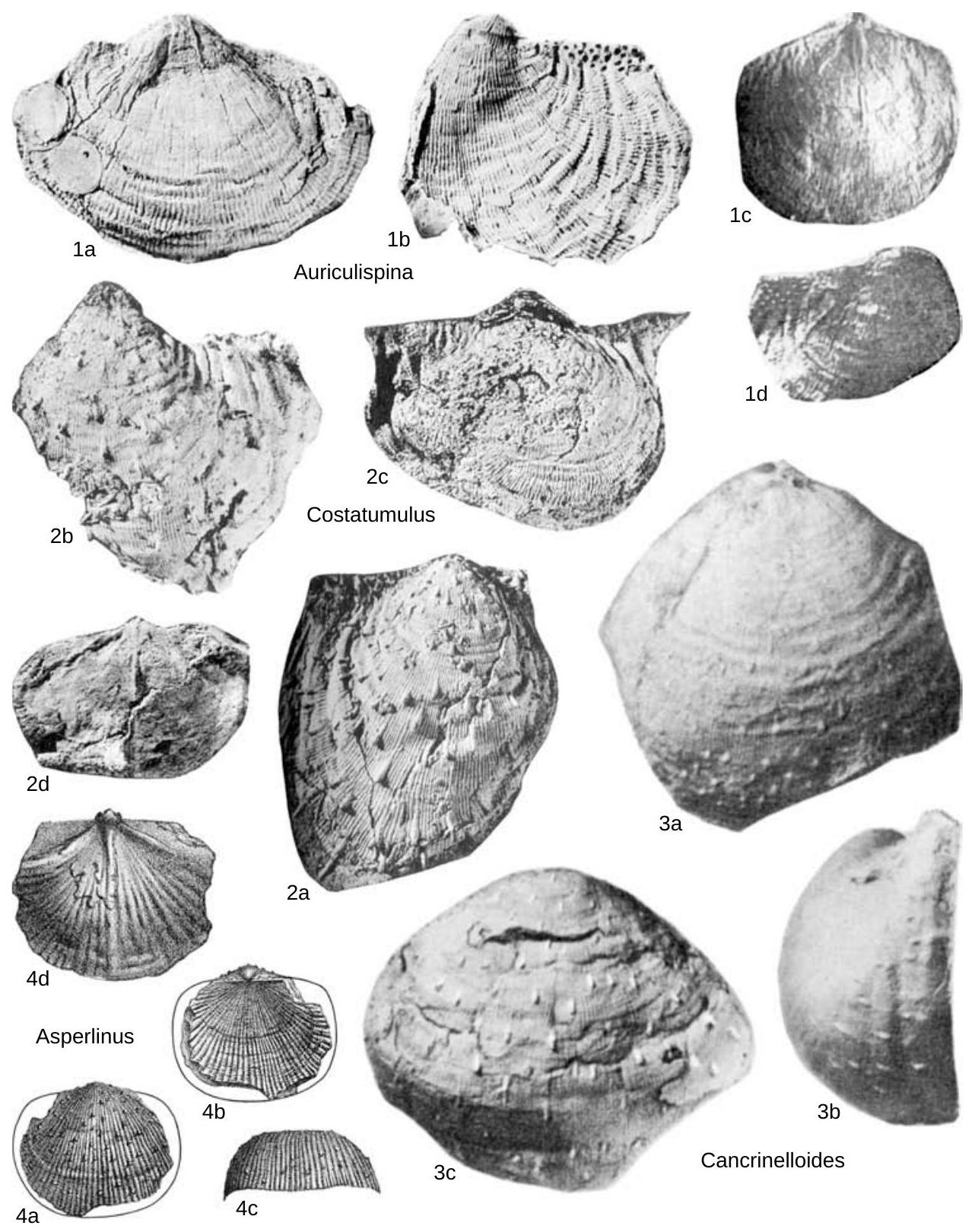 Fig. 376, 2a-d. * C. tumidus (Waterhouse, Briggs, & Parfrey), Lower Permian, Elvinia Formation, Bowen basin, Australia, a, replica of ventral valve exterior, x1.5, b, replica of incomplete ventral valve exterior, x1.5, c, dorsal valve external mold, x1 . 5, ~ d, replica of dorsal valve interior, x1.5 (Waterhouse & Briggs, 1986). -- Fig. 1765, 1a-c. C. tazawai Shen & others, Lopingian, southern Tibet, a, holotype, ventral valve exterior, NMV P148917, x1.5, b, ventral valve exterior with elongate spine bases, x1.5, c, external mold of a dorsal valve showing one ear, x1.5 (Shen & others, 2000).
Synonyms
Auritusinia
Geographic Distribution
Australia, central and ?eastern Himalayas
Age Range
Beginning Stage in Treatise Usage:
Lower Permian (Artinskian)
Beginning International Stage:
Artinskian
Fraction Up In Beginning Stage:
0
Beginning Date:
290.51
Ending Stage in Treatise Usage:
Lower Permian (Artinskian)
Ending International Stage:
Artinskian
Fraction Up In Ending Stage:
100
Ending Date:
283.3
Description
Similar to Cancrinelloides with double row of spines close to ventral hinge, but possibly with less regular rugae, elongate spine bases continuing to ventral valve margin. [The only points of differentiation given by Waterhouse (2002b) for separating C. tazawai from Costatamulus are more strongly developed rugae and more strongly developed ears on the new genus. Comparisons of the original descriptions and illustrations by Waterhouse (1986) and SHEN and others (2000) show similar ears and only some difference in the development of rugae, which tends to be a variable character. The type species of Costatamulus is Lower Permian in age, and that of Auritusinia is upper Upper Permian. The type species, C. tumidus, was illustrated in the genus entry of the Treatise (Brunton & others, 2000, p. 538). Here a second species from younger strata is illustrated.]
References
Museum or Author Information
Classification
Phylum:
Brachiopoda
Subphylum:
Rhynchonelliformea
Class:
Strophomenata
Order:
Productida
Suborder:
Productidina
Superfamily:
Linoproductoidea
Family:
Monticuliferidae
Subfamily:
Auriculispininae (Tribe Auriculispinini)
Formal Genus Name and Reference:
Costatumulus Waterhouse in Waterhouse & Briggs, 1986, p. 58
Type Species:
Auriculispina tumidus Waterhouse, Briggs, & PARFREY, 1983, p. 133, OD
Images
(Click to enlarge in a new window)
Fig. 376, 2a-d. * C. tumidus (Waterhouse, Briggs, & Parfrey), Lower Permian, Elvinia Formation, Bowen basin, Australia, a, replica of ventral valve exterior, x1.5, b, replica of incomplete ventral valve exterior, x1.5, c, dorsal valve external mold, x1 . 5, ~ d, replica of dorsal valve interior, x1.5 (Waterhouse & Briggs, 1986). -- Fig. 1765, 1a-c. C. tazawai Shen & others, Lopingian, southern Tibet, a, holotype, ventral valve exterior, NMV P148917, x1.5, b, ventral valve exterior with elongate spine bases, x1.5, c, external mold of a dorsal valve showing one ear, x1.5 (Shen & others, 2000).
Synonyms
Auritusinia
Geographic Distribution
Australia, central and ?eastern Himalayas
Age Range
Beginning Stage in Treatise Usage:
Lower Permian (Artinskian)
Beginning International Stage:
Artinskian
Fraction Up In Beginning Stage:
0
Beginning Date:
290.51
Ending Stage in Treatise Usage:
Lower Permian (Artinskian)
Ending International Stage:
Artinskian
Fraction Up In Ending Stage:
100
Ending Date:
283.3
Description
Similar to Cancrinelloides with double row of spines close to ventral hinge, but possibly with less regular rugae, elongate spine bases continuing to ventral valve margin. [The only points of differentiation given by Waterhouse (2002b) for separating C. tazawai from Costatamulus are more strongly developed rugae and more strongly developed ears on the new genus. Comparisons of the original descriptions and illustrations by Waterhouse (1986) and SHEN and others (2000) show similar ears and only some difference in the development of rugae, which tends to be a variable character. The type species of Costatamulus is Lower Permian in age, and that of Auritusinia is upper Upper Permian. The type species, C. tumidus, was illustrated in the genus entry of the Treatise (Brunton & others, 2000, p. 538). Here a second species from younger strata is illustrated.]