
Welcome to the Brachiopod subsite on Invertebrate Paleontology!
Please enter a genera name to retrieve more information.

Crassipunctatrypa
Classification
Phylum:
Brachiopoda
Subphylum:
Rhynchonelliformea
Class:
Rhynchonellata
Order:
Atrypida
Suborder:
Atrypidina
Superfamily:
Punctatrypoidea
Family:
Punctatrypidae
Subfamily:
Punctatrypinae
Formal Genus Name and Reference:
Crassipunctatrypa Mizens & RZHONSNITSKAIA, 1979, p. 63
Type Species:
Punctatrypa crassiconcentrica MIZENS, 1977b, p. 93, OD
Images
(Click to enlarge in a new window)
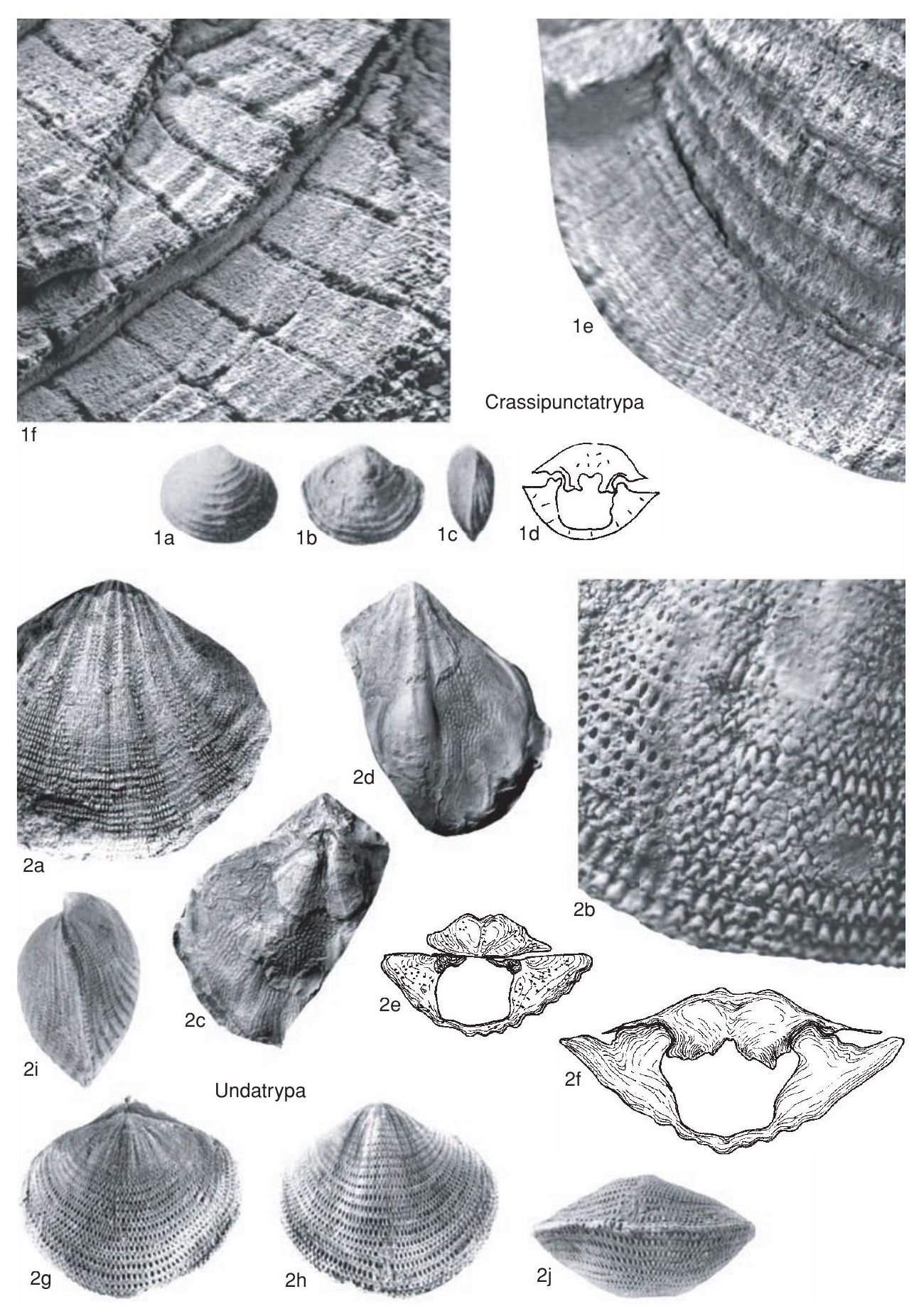 Fig. 973, 1a-f. *C. crassiconcentrica (Mizens), Emsian, Turkestan, a-c, dorsal, ventral, lateral views, x1, d, serial section, x2.5 (Mizens, 1984), e, SEM view of growth lamellae, x14, f, SEM view of fenestrae, x43 (new).
Synonyms
Geographic Distribution
Urals, central Asia, Tian Shan
Age Range
Beginning Stage in Treatise Usage:
Lower Devonian (upper Pragian)
Beginning International Stage:
Pragian
Fraction Up In Beginning Stage:
50
Beginning Date:
411.46
Ending Stage in Treatise Usage:
Middle Devonian (middle Eifelian)
Ending International Stage:
Eifelian
Fraction Up In Ending Stage:
66
Ending Date:
388.36
Description
Small to medium, rounded, biconvex; small beak; minute anacline-orthocline area; apical foramen bisecting deltidial plates; surface covered by very fine ribs posteriorly, tending to fade anteriorly, ribbing absent on growth lamellae; concentric, flat, weakly deflected growth lamellae protruding as overlapping, flat frills, possessing narrow, radial, linear grooves; concentric anterior fenestrae partially roofed over by growth lamellae; commissure rectimarginate to weakly plicate; solid teeth; hinge plates delicate; spiralia, jugal processes undescribed. [Distinguished from Punctatrypa and others by its unique, flat growth lamellae with radiating linear grooves, rib loss anteriorly, hidden fenestrae
References
Museum or Author Information
Classification
Phylum:
Brachiopoda
Subphylum:
Rhynchonelliformea
Class:
Rhynchonellata
Order:
Atrypida
Suborder:
Atrypidina
Superfamily:
Punctatrypoidea
Family:
Punctatrypidae
Subfamily:
Punctatrypinae
Formal Genus Name and Reference:
Crassipunctatrypa Mizens & RZHONSNITSKAIA, 1979, p. 63
Type Species:
Punctatrypa crassiconcentrica MIZENS, 1977b, p. 93, OD
Images
(Click to enlarge in a new window)
Fig. 973, 1a-f. *C. crassiconcentrica (Mizens), Emsian, Turkestan, a-c, dorsal, ventral, lateral views, x1, d, serial section, x2.5 (Mizens, 1984), e, SEM view of growth lamellae, x14, f, SEM view of fenestrae, x43 (new).
Synonyms
Geographic Distribution
Urals, central Asia, Tian Shan
Age Range
Beginning Stage in Treatise Usage:
Lower Devonian (upper Pragian)
Beginning International Stage:
Pragian
Fraction Up In Beginning Stage:
50
Beginning Date:
411.46
Ending Stage in Treatise Usage:
Middle Devonian (middle Eifelian)
Ending International Stage:
Eifelian
Fraction Up In Ending Stage:
66
Ending Date:
388.36
Description
Small to medium, rounded, biconvex; small beak; minute anacline-orthocline area; apical foramen bisecting deltidial plates; surface covered by very fine ribs posteriorly, tending to fade anteriorly, ribbing absent on growth lamellae; concentric, flat, weakly deflected growth lamellae protruding as overlapping, flat frills, possessing narrow, radial, linear grooves; concentric anterior fenestrae partially roofed over by growth lamellae; commissure rectimarginate to weakly plicate; solid teeth; hinge plates delicate; spiralia, jugal processes undescribed. [Distinguished from Punctatrypa and others by its unique, flat growth lamellae with radiating linear grooves, rib loss anteriorly, hidden fenestrae