
Welcome to the Brachiopod subsite on Invertebrate Paleontology!
Please enter a genera name to retrieve more information.
Cyclothyris
Classification
Phylum:
Brachiopoda
Subphylum:
Rhynchonelliformea
Class:
Rhynchonellata
Order:
Rhynchonellida
Superfamily:
Hemithiridoidea
Family:
Cyclothyrididae
Subfamily:
Cyclothyridinae
Formal Genus Name and Reference:
Cyclothyris M'COR, 1844, p. 103
Type Species:
Terebratula latissima J. de C. Sowerby, 1840 in 1840-1846, index, p. 7, SD Buckman, 1906, p. 326, =T. lata J. de C. Sowerby, 1825 in 1823-1825, p. 165, non J. SOWERBY, 1815
Images
(Click to enlarge in a new window)
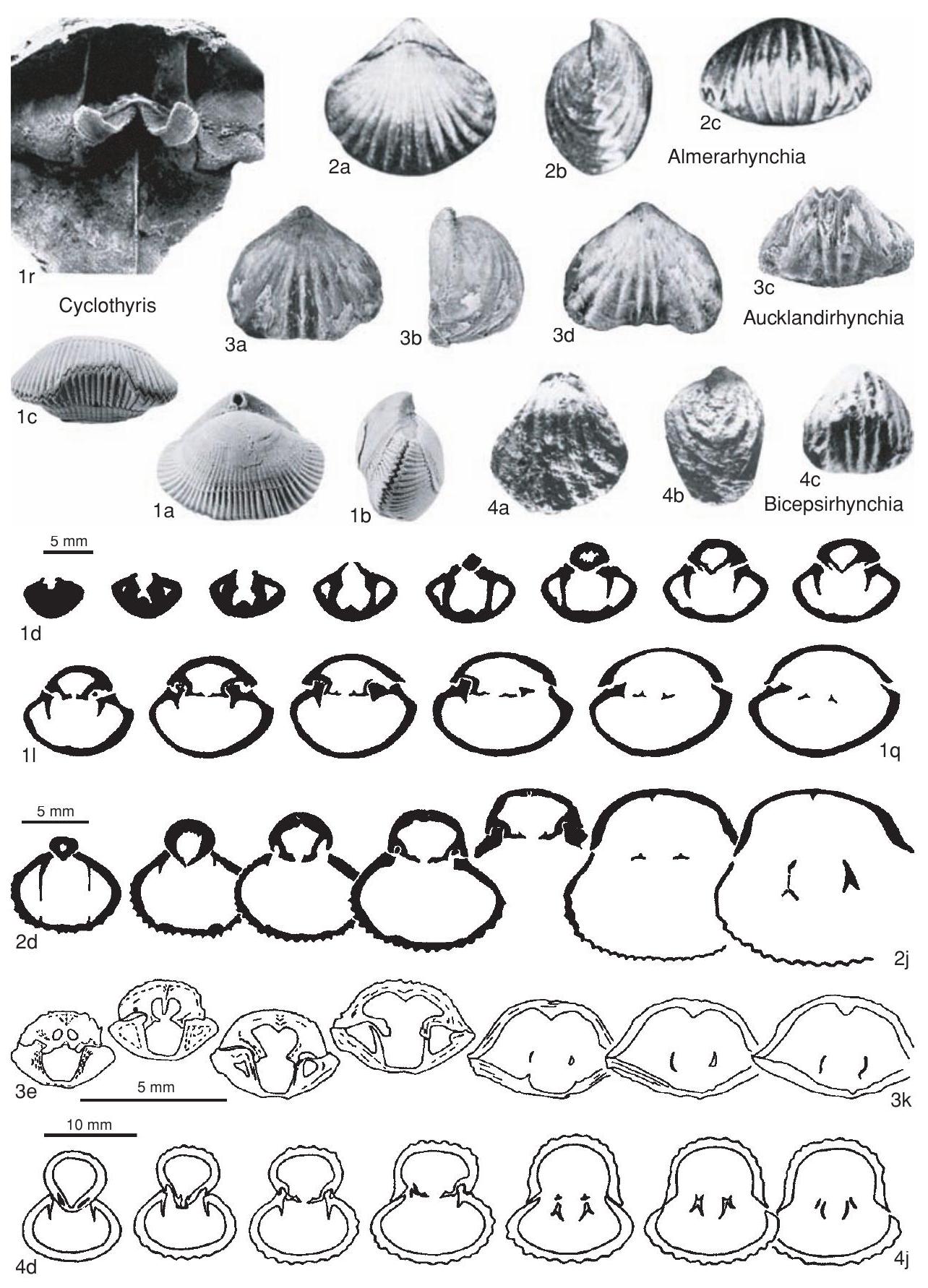 Fig. 900, 1a-q. * C. latissima (J. de C. Sowerby), upper Aptian, Berkshire, England, a- c, topotype, dorsal, lateral, anterior views, BMNH BB.41494, x1 (new), d-q, topotype, transverse serial sections, distances in mm from ventral umbo, 1.3, 1.7, 2.3, 2.7, 3.2, 3.6, 3.9, 4.1, 4.4, 4.8, 5.1, 5.3, 5.6, 5.8, BMNH BB. 5482 (Owen, 1962).
Synonyms
Cyclothiris
Geographic Distribution
England, France, Germany, Switzerland, Belgium, Poland, Romania, Bulgaria, Spain, Slovakia, Yugoslavia, Russia, Morocco, South Africa, Madagascar, ?Pakistan, India, Turkmenistan, USA, Chile
Age Range
Beginning Stage in Treatise Usage:
Lower Cretaceous (Aptian)
Beginning International Stage:
Aptian
Fraction Up In Beginning Stage:
0
Beginning Date:
121.4
Ending Stage in Treatise Usage:
Upper Cretaceous (Maastrichtian)
Ending International Stage:
Maastrichtian
Fraction Up In Ending Stage:
100
Ending Date:
66.04
Description
Medium to large, wide, with uniplication low, arcuate, commonly asymmetrical, costellae numerous, fine posteriorly, given to bifurcation and antidichotomy anteriorly, beak erect, foramen large, auriculate, deltidial plates conjunct, well exposed. Dorsal septum short or absent, hinge plates distally concave, crura long, dorsally concave.
References
Museum or Author Information
Classification
Phylum:
Brachiopoda
Subphylum:
Rhynchonelliformea
Class:
Rhynchonellata
Order:
Rhynchonellida
Superfamily:
Hemithiridoidea
Family:
Cyclothyrididae
Subfamily:
Cyclothyridinae
Formal Genus Name and Reference:
Cyclothyris M'COR, 1844, p. 103
Type Species:
Terebratula latissima J. de C. Sowerby, 1840 in 1840-1846, index, p. 7, SD Buckman, 1906, p. 326, =T. lata J. de C. Sowerby, 1825 in 1823-1825, p. 165, non J. SOWERBY, 1815
Images
(Click to enlarge in a new window)
Fig. 900, 1a-q. * C. latissima (J. de C. Sowerby), upper Aptian, Berkshire, England, a- c, topotype, dorsal, lateral, anterior views, BMNH BB.41494, x1 (new), d-q, topotype, transverse serial sections, distances in mm from ventral umbo, 1.3, 1.7, 2.3, 2.7, 3.2, 3.6, 3.9, 4.1, 4.4, 4.8, 5.1, 5.3, 5.6, 5.8, BMNH BB. 5482 (Owen, 1962).
Synonyms
Cyclothiris
Geographic Distribution
England, France, Germany, Switzerland, Belgium, Poland, Romania, Bulgaria, Spain, Slovakia, Yugoslavia, Russia, Morocco, South Africa, Madagascar, ?Pakistan, India, Turkmenistan, USA, Chile
Age Range
Beginning Stage in Treatise Usage:
Lower Cretaceous (Aptian)
Beginning International Stage:
Aptian
Fraction Up In Beginning Stage:
0
Beginning Date:
121.4
Ending Stage in Treatise Usage:
Upper Cretaceous (Maastrichtian)
Ending International Stage:
Maastrichtian
Fraction Up In Ending Stage:
100
Ending Date:
66.04
Description
Medium to large, wide, with uniplication low, arcuate, commonly asymmetrical, costellae numerous, fine posteriorly, given to bifurcation and antidichotomy anteriorly, beak erect, foramen large, auriculate, deltidial plates conjunct, well exposed. Dorsal septum short or absent, hinge plates distally concave, crura long, dorsally concave.