
Welcome to the Brachiopod subsite on Invertebrate Paleontology!
Please enter a genera name to retrieve more information.
Eoanastrophia
Classification
Phylum:
Brachiopoda
Subphylum:
Rhynchonelliformea
Class:
Rhynchonellata
Order:
Pentamerida
Suborder:
Syntrophiidina
Superfamily:
Camerelloidea
Family:
Parastrophinidae
Formal Genus Name and Reference:
Eoanastrophia Nikiforova & SAPELNIKOV, 1973, p. 65
Type Species:
E. antiquata, OD
Images
(Click to enlarge in a new window)
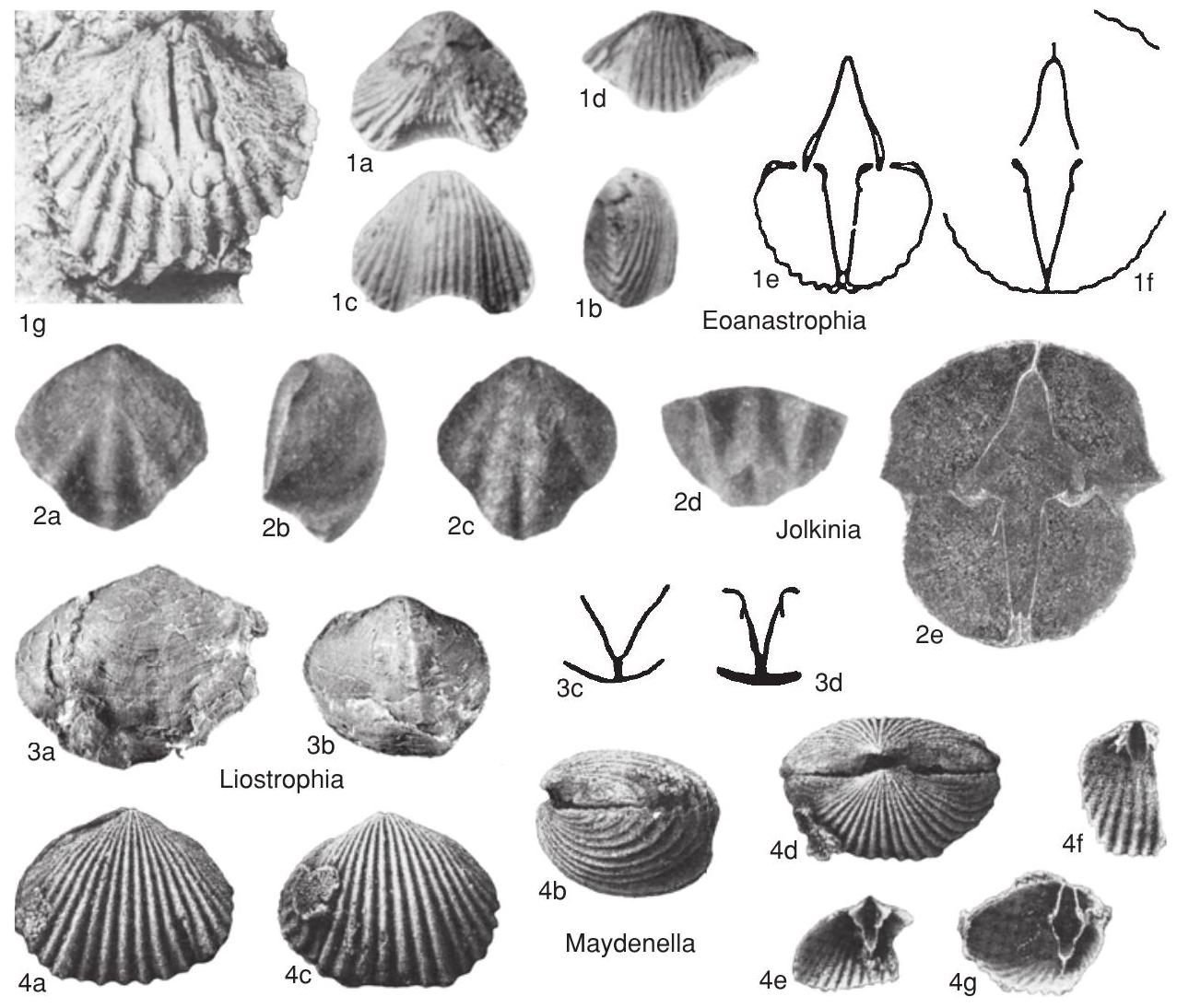 Fig. 641, 1a-f. *E. antiquata, Caradoc or Ashgill, Zeravshan Range, Tadzhikistan, a, ventral valve exterior, b, articulated valves, lateral view, ventral on left, c, dorsal valve exterior, d, articulated valves, anterior view, ventral valve above, x1, e-f, serial sections 0.6 and 0.9 mm from posterior end of specimen, ventral valve above, x3.5 (Nikiforova & Sapelnikov, 1973).—Fig. 641, 1g. E. pentamera (Meneghini), Ashgill, Rosan Formation, Armorican Massif, France, dorsal valve interior mold, x2 (Melou, 1990).
Synonyms
Geographic Distribution
Russia, Kirgizia, Kazakhstan, Europe
Age Range
Beginning Stage in Treatise Usage:
Upper Ordovician (Caradoc)
Beginning International Stage:
Sandbian
Fraction Up In Beginning Stage:
0
Beginning Date:
458.18
Ending Stage in Treatise Usage:
Upper Ordovician (Ashgill)
Ending International Stage:
Hirnantian
Fraction Up In Ending Stage:
100
Ending Date:
443.07
Description
Similar to Anastrophia externally but uniplication broad and shallow, present on entire valve, teeth weak, deep, narrow spondylium duplex supported along entire length by low median septum that does not extend anterior to spondylium, socket plates converge to form deep, narrow septalium simplex supported on long, low median septum, alate plates may be weakly developed or rarely absent
References
Museum or Author Information
Classification
Phylum:
Brachiopoda
Subphylum:
Rhynchonelliformea
Class:
Rhynchonellata
Order:
Pentamerida
Suborder:
Syntrophiidina
Superfamily:
Camerelloidea
Family:
Parastrophinidae
Formal Genus Name and Reference:
Eoanastrophia Nikiforova & SAPELNIKOV, 1973, p. 65
Type Species:
E. antiquata, OD
Images
(Click to enlarge in a new window)
Fig. 641, 1a-f. *E. antiquata, Caradoc or Ashgill, Zeravshan Range, Tadzhikistan, a, ventral valve exterior, b, articulated valves, lateral view, ventral on left, c, dorsal valve exterior, d, articulated valves, anterior view, ventral valve above, x1, e-f, serial sections 0.6 and 0.9 mm from posterior end of specimen, ventral valve above, x3.5 (Nikiforova & Sapelnikov, 1973).—Fig. 641, 1g. E. pentamera (Meneghini), Ashgill, Rosan Formation, Armorican Massif, France, dorsal valve interior mold, x2 (Melou, 1990).
Synonyms
Geographic Distribution
Russia, Kirgizia, Kazakhstan, Europe
Age Range
Beginning Stage in Treatise Usage:
Upper Ordovician (Caradoc)
Beginning International Stage:
Sandbian
Fraction Up In Beginning Stage:
0
Beginning Date:
458.18
Ending Stage in Treatise Usage:
Upper Ordovician (Ashgill)
Ending International Stage:
Hirnantian
Fraction Up In Ending Stage:
100
Ending Date:
443.07
Description
Similar to Anastrophia externally but uniplication broad and shallow, present on entire valve, teeth weak, deep, narrow spondylium duplex supported along entire length by low median septum that does not extend anterior to spondylium, socket plates converge to form deep, narrow septalium simplex supported on long, low median septum, alate plates may be weakly developed or rarely absent