
Welcome to the Brachiopod subsite on Invertebrate Paleontology!
Please enter a genera name to retrieve more information.

Halorella
Classification
Phylum:
Brachiopoda
Subphylum:
Rhynchonelliformea
Class:
Rhynchonellata
Order:
Rhynchonellida
Superfamily:
Dimerelloidea
Family:
Halorellidae?
Formal Genus Name and Reference:
Halorella BITTNER, 1884, p. 107
Type Species:
Rhynchonella amphitoma Bronn, 1832, p. 162, SD Hall & CLARKE, 1894, p. 832
Images
(Click to enlarge in a new window)
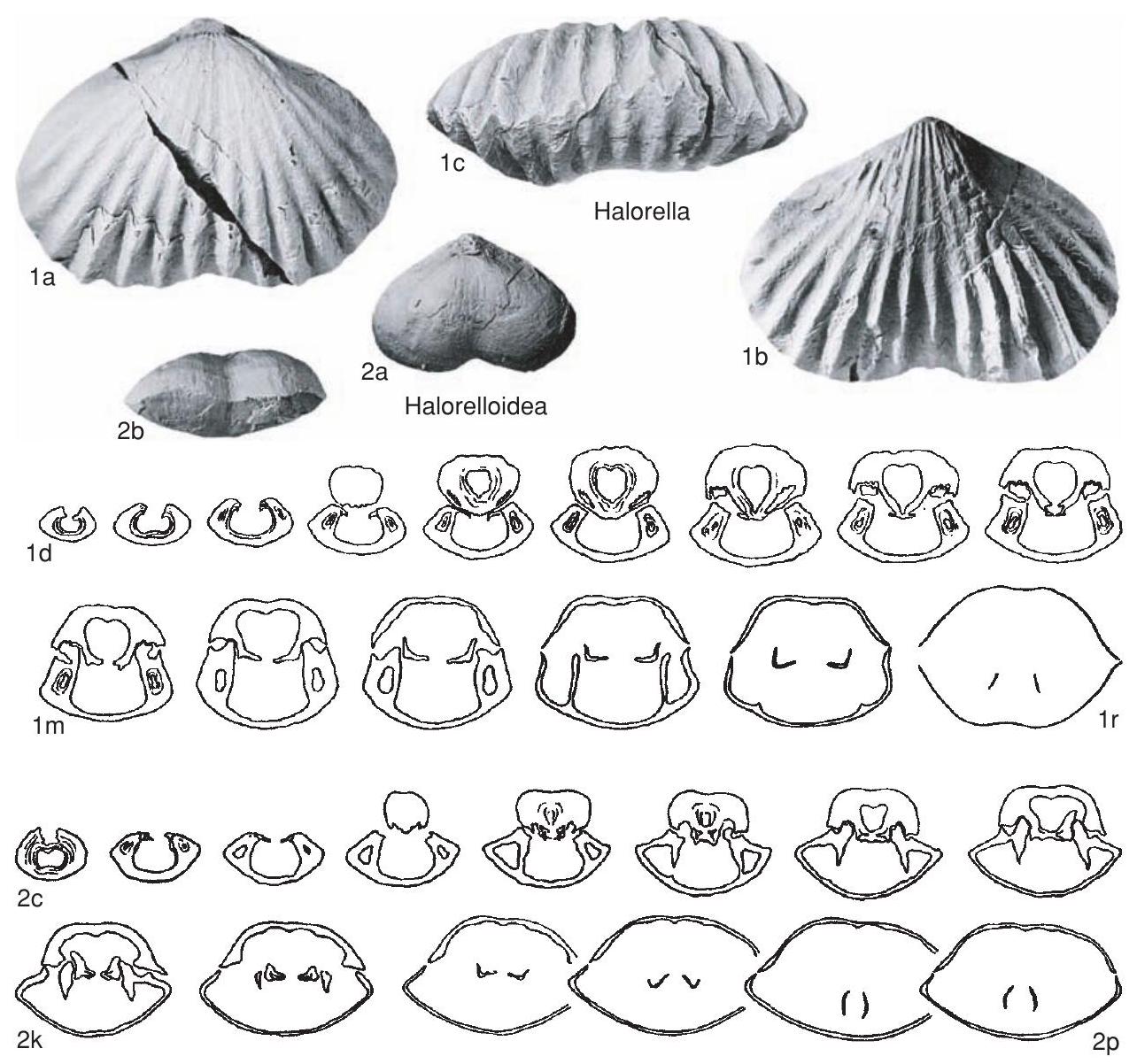 Fig. 847, 1 a-r .*H. amphitoma (Bronn), Norian, Pamirs, a-c, dorsal, ventral, anterior views, IGiG 200/6, x1, d-r, transverse serial sections, distances in mm from first section, 0.0, 0.3, 0.6, 1.2, 1.8, 2.4, 2.7, 3.1, 3.3, 3.6, 4.1, 4.6, 5.3, 5.9, 6.7 (Dagys, 1963).
Synonyms
Geographic Distribution
Alps, Carpathians, Turkey, Pamirs, northeastern Siberia, China, Indonesia, western USA, New Zealand
Age Range
Beginning Stage in Treatise Usage:
Upper Triassic (?upper Carnian, Norian)
Beginning International Stage:
Carnian
Fraction Up In Beginning Stage:
26.1
Beginning Date:
234.47
Ending Stage in Treatise Usage:
Upper Triassic (?upper Carnian, Norian)
Ending International Stage:
Carnian
Fraction Up In Ending Stage:
100
Ending Date:
227.3
Description
Medium size to large, transverse oval to subpentagonal with sharp costae beginning from umbo, sulci on both valves or uniplicate, beak suberect, ridges sharp, foramen oval, hypothyrid, deltidial plates conjunct. Dental plates distinct, ventrally divergent, pedicle collar present, septum weak or absent, long ciliform crura.
References
Museum or Author Information
Classification
Phylum:
Brachiopoda
Subphylum:
Rhynchonelliformea
Class:
Rhynchonellata
Order:
Rhynchonellida
Superfamily:
Dimerelloidea
Family:
Halorellidae?
Formal Genus Name and Reference:
Halorella BITTNER, 1884, p. 107
Type Species:
Rhynchonella amphitoma Bronn, 1832, p. 162, SD Hall & CLARKE, 1894, p. 832
Images
(Click to enlarge in a new window)
Fig. 847, 1 a-r .*H. amphitoma (Bronn), Norian, Pamirs, a-c, dorsal, ventral, anterior views, IGiG 200/6, x1, d-r, transverse serial sections, distances in mm from first section, 0.0, 0.3, 0.6, 1.2, 1.8, 2.4, 2.7, 3.1, 3.3, 3.6, 4.1, 4.6, 5.3, 5.9, 6.7 (Dagys, 1963).
Synonyms
Geographic Distribution
Alps, Carpathians, Turkey, Pamirs, northeastern Siberia, China, Indonesia, western USA, New Zealand
Age Range
Beginning Stage in Treatise Usage:
Upper Triassic (?upper Carnian, Norian)
Beginning International Stage:
Carnian
Fraction Up In Beginning Stage:
26.1
Beginning Date:
234.47
Ending Stage in Treatise Usage:
Upper Triassic (?upper Carnian, Norian)
Ending International Stage:
Carnian
Fraction Up In Ending Stage:
100
Ending Date:
227.3
Description
Medium size to large, transverse oval to subpentagonal with sharp costae beginning from umbo, sulci on both valves or uniplicate, beak suberect, ridges sharp, foramen oval, hypothyrid, deltidial plates conjunct. Dental plates distinct, ventrally divergent, pedicle collar present, septum weak or absent, long ciliform crura.