
Welcome to the Brachiopod subsite on Invertebrate Paleontology!
Please enter a genera name to retrieve more information.

Karpinskia
Classification
Phylum:
Brachiopoda
Subphylum:
Rhynchonelliformea
Class:
Rhynchonellata
Order:
Atrypida
Suborder:
Davidsoniidina
Superfamily:
Palaferelloidea
Family:
Karpinskiidae
Subfamily:
Karpinskiinae
Formal Genus Name and Reference:
Karpinskia CHERNYSHEV, 1885, p. 48
Type Species:
K. conjugula, OD
Images
(Click to enlarge in a new window)
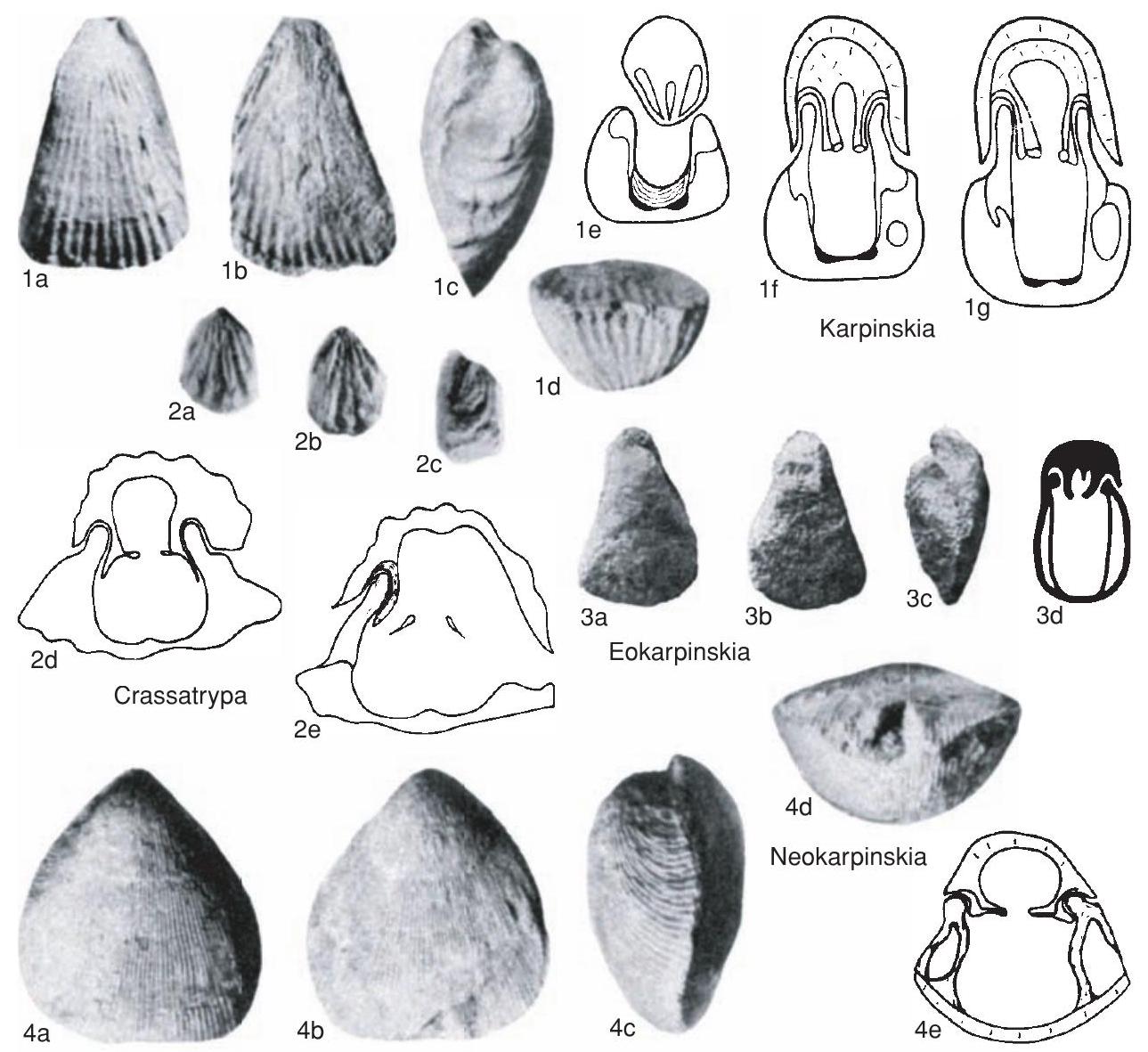 Fig. 984, 1a-g. *K. conjugula, Emsian, western slopes, Urals, a-d, dorsal, ventral, lateral, anterior views, x1, e-g, serial sections, x2.5 (Mizens, 1984).
Synonyms
Geographic Distribution
southern Europe, Urals, central Asia, China (Xinjiang)
Age Range
Beginning Stage in Treatise Usage:
Lower Devonian (Emsian)
Beginning International Stage:
Emsian
Fraction Up In Beginning Stage:
0
Beginning Date:
410.51
Ending Stage in Treatise Usage:
Lower Devonian (Emsian)
Ending International Stage:
Emsian
Fraction Up In Ending Stage:
100
Ending Date:
394.3
Description
Medium to large, highly elongate, narrow, rectangular to triangular, laterally compressed, roughly squared in anterior view, dorsibiconvex, convexoplane, protruding beak, short hinge, acute hinge angle, apsacline-orthocline area, prominent apical foramen, thick deltidial plates, ribs fine apically, nonbifurcating, to very coarse anteriorly, zigzag at commissure, wide, high, subrectangular, plicate commissure, thick shell wall, weak vascular ridges, medium to thick pedicle callist-collar, long, narrow teeth, elongated dental cavities, thick hinge plate, long, thin socket plates, small crural bases, crura, dorsally directed spiralia with fewer than 13 whorls, jugal processes undescribed. [Differentiated from Karpinskia by small size, coarser ribs posteriorly, rhynchonelliform shape, differs from Vagrania by its elongate outline, anteriorly coarse ribs.]
References
Museum or Author Information
Classification
Phylum:
Brachiopoda
Subphylum:
Rhynchonelliformea
Class:
Rhynchonellata
Order:
Atrypida
Suborder:
Davidsoniidina
Superfamily:
Palaferelloidea
Family:
Karpinskiidae
Subfamily:
Karpinskiinae
Formal Genus Name and Reference:
Karpinskia CHERNYSHEV, 1885, p. 48
Type Species:
K. conjugula, OD
Images
(Click to enlarge in a new window)
Fig. 984, 1a-g. *K. conjugula, Emsian, western slopes, Urals, a-d, dorsal, ventral, lateral, anterior views, x1, e-g, serial sections, x2.5 (Mizens, 1984).
Synonyms
Geographic Distribution
southern Europe, Urals, central Asia, China (Xinjiang)
Age Range
Beginning Stage in Treatise Usage:
Lower Devonian (Emsian)
Beginning International Stage:
Emsian
Fraction Up In Beginning Stage:
0
Beginning Date:
410.51
Ending Stage in Treatise Usage:
Lower Devonian (Emsian)
Ending International Stage:
Emsian
Fraction Up In Ending Stage:
100
Ending Date:
394.3
Description
Medium to large, highly elongate, narrow, rectangular to triangular, laterally compressed, roughly squared in anterior view, dorsibiconvex, convexoplane, protruding beak, short hinge, acute hinge angle, apsacline-orthocline area, prominent apical foramen, thick deltidial plates, ribs fine apically, nonbifurcating, to very coarse anteriorly, zigzag at commissure, wide, high, subrectangular, plicate commissure, thick shell wall, weak vascular ridges, medium to thick pedicle callist-collar, long, narrow teeth, elongated dental cavities, thick hinge plate, long, thin socket plates, small crural bases, crura, dorsally directed spiralia with fewer than 13 whorls, jugal processes undescribed. [Differentiated from Karpinskia by small size, coarser ribs posteriorly, rhynchonelliform shape, differs from Vagrania by its elongate outline, anteriorly coarse ribs.]