
Welcome to the Brachiopod subsite on Invertebrate Paleontology!
Please enter a genera name to retrieve more information.
Kransia
Classification
Phylum:
Brachiopoda
Subphylum:
Rhynchonelliformea
Class:
Rhynchonellata
Order:
Rhynchonellida
Superfamily:
Uncinuloidea
Family:
Hebetoechiidae
Subfamily:
Betterbergiinae
Formal Genus Name and Reference:
Kransia WESTBROEK, 1968, p. 81
Type Species:
Terebratula parallelepipeda BRONN, 1837, p. 71, OD
Images
(Click to enlarge in a new window)
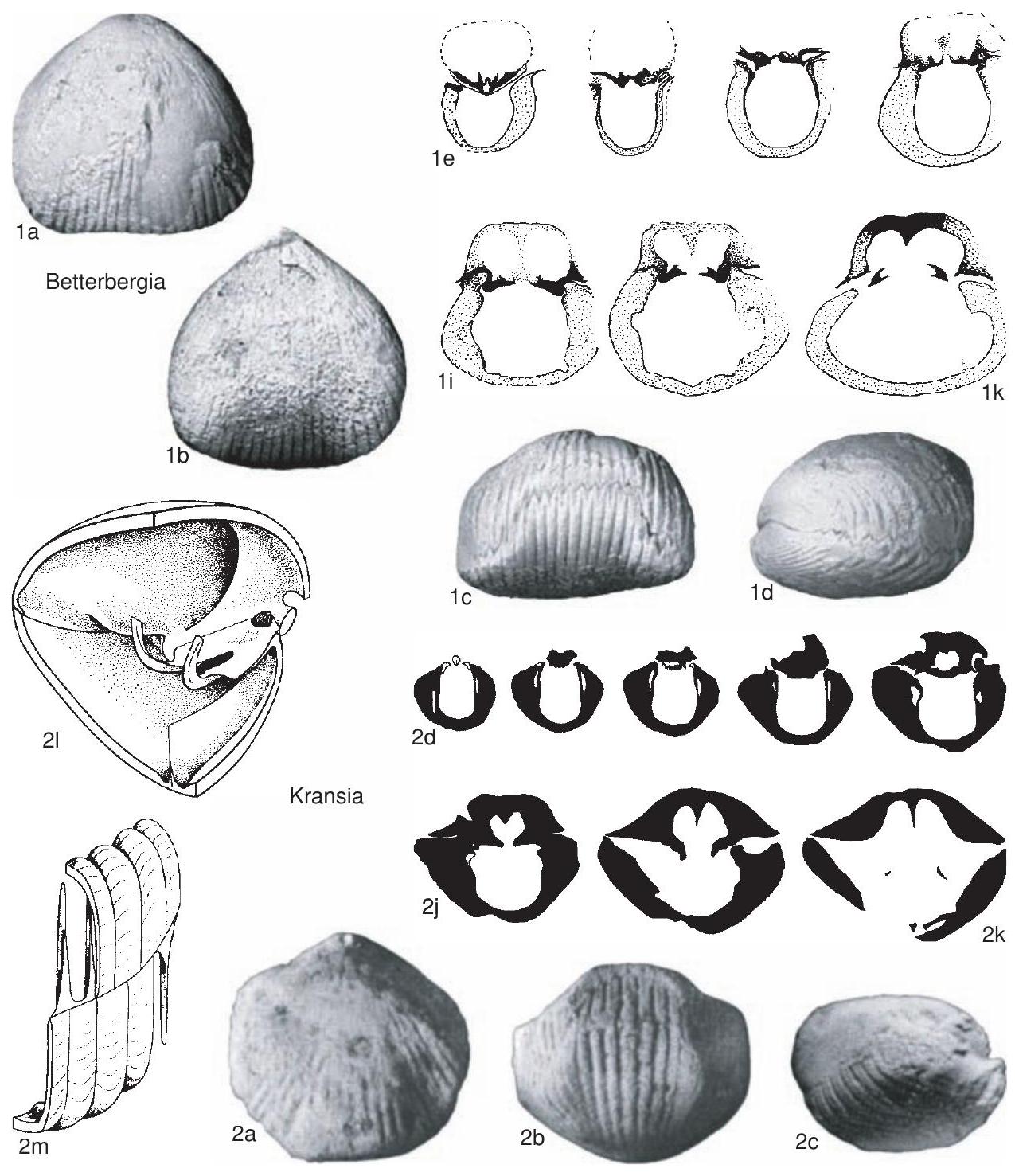 Fig. 754, 2a-m. *K. parallelepipeda (Bronn), Givetian, a, hypotype, dorsal view, x3, b, hypotype, anterior view, c, lateral view of another hypotype, x3, d-k, hypotype, serial sections 0.4, 0.5, 0.6, 0.7, 0.9, 1.2, 1.4, 1.7 ~mm from posterior, upper Givetian, northwestern France, x4 (Brice & Morzadec, 1983), l, reconstruction of apical interior, based on serial sections, m, reconstruction of marginal spines, based on serial sections (Westbroek, 1968).
Synonyms
Geographic Distribution
Europe, northern Africa, Urals, Afghanistan, China
Age Range
Beginning Stage in Treatise Usage:
Lower Devonian (Emsian)
Beginning International Stage:
Emsian
Fraction Up In Beginning Stage:
0
Beginning Date:
410.51
Ending Stage in Treatise Usage:
Middle Devonian (Givetian)
Ending International Stage:
Givetian
Fraction Up In Ending Stage:
100
Ending Date:
378.9
Description
A fossil with a subpentagonal outline and strongly biconvex profile, it has an erect beak and a well-developed mesothyrid foramen with small, conjunct deltidial plates, squamae and glottae are present, the fold and sulcus are weak, with a high, rounded tongue, the costae are simple, arising on umbones, flattened anteriorly, and grooved to accommodate long marginal spines, the dental plates are short, subparallel, and close to valve walls, the ventral muscle scars are deeply impressed in a thick shell, the dorsal median septum is low and long, and the septalium is short, the cardinal process bears several longitudinal ridges, the hinge plates are united anterior of the septalium
References
Museum or Author Information
Classification
Phylum:
Brachiopoda
Subphylum:
Rhynchonelliformea
Class:
Rhynchonellata
Order:
Rhynchonellida
Superfamily:
Uncinuloidea
Family:
Hebetoechiidae
Subfamily:
Betterbergiinae
Formal Genus Name and Reference:
Kransia WESTBROEK, 1968, p. 81
Type Species:
Terebratula parallelepipeda BRONN, 1837, p. 71, OD
Images
(Click to enlarge in a new window)
Fig. 754, 2a-m. *K. parallelepipeda (Bronn), Givetian, a, hypotype, dorsal view, x3, b, hypotype, anterior view, c, lateral view of another hypotype, x3, d-k, hypotype, serial sections 0.4, 0.5, 0.6, 0.7, 0.9, 1.2, 1.4, 1.7 ~mm from posterior, upper Givetian, northwestern France, x4 (Brice & Morzadec, 1983), l, reconstruction of apical interior, based on serial sections, m, reconstruction of marginal spines, based on serial sections (Westbroek, 1968).
Synonyms
Geographic Distribution
Europe, northern Africa, Urals, Afghanistan, China
Age Range
Beginning Stage in Treatise Usage:
Lower Devonian (Emsian)
Beginning International Stage:
Emsian
Fraction Up In Beginning Stage:
0
Beginning Date:
410.51
Ending Stage in Treatise Usage:
Middle Devonian (Givetian)
Ending International Stage:
Givetian
Fraction Up In Ending Stage:
100
Ending Date:
378.9
Description
A fossil with a subpentagonal outline and strongly biconvex profile, it has an erect beak and a well-developed mesothyrid foramen with small, conjunct deltidial plates, squamae and glottae are present, the fold and sulcus are weak, with a high, rounded tongue, the costae are simple, arising on umbones, flattened anteriorly, and grooved to accommodate long marginal spines, the dental plates are short, subparallel, and close to valve walls, the ventral muscle scars are deeply impressed in a thick shell, the dorsal median septum is low and long, and the septalium is short, the cardinal process bears several longitudinal ridges, the hinge plates are united anterior of the septalium