
Welcome to the Brachiopod subsite on Invertebrate Paleontology!
Please enter a genera name to retrieve more information.
Krotovia
Classification
Phylum:
Brachiopoda
Subphylum:
Rhynchonelliformea
Class:
Strophomenata
Order:
Productida
Suborder:
Productidina
Superfamily:
Productoidea
Family:
Productellidae
Subfamily:
Overtoniinae (Tribe Krotoviini)
Formal Genus Name and Reference:
Krotovia FREDERICKS, 1928, p. 779
Type Species:
Productus spinulosus J. SOWERBY, 1814 in 1812-1815, p. 155, OD
Images
(Click to enlarge in a new window)
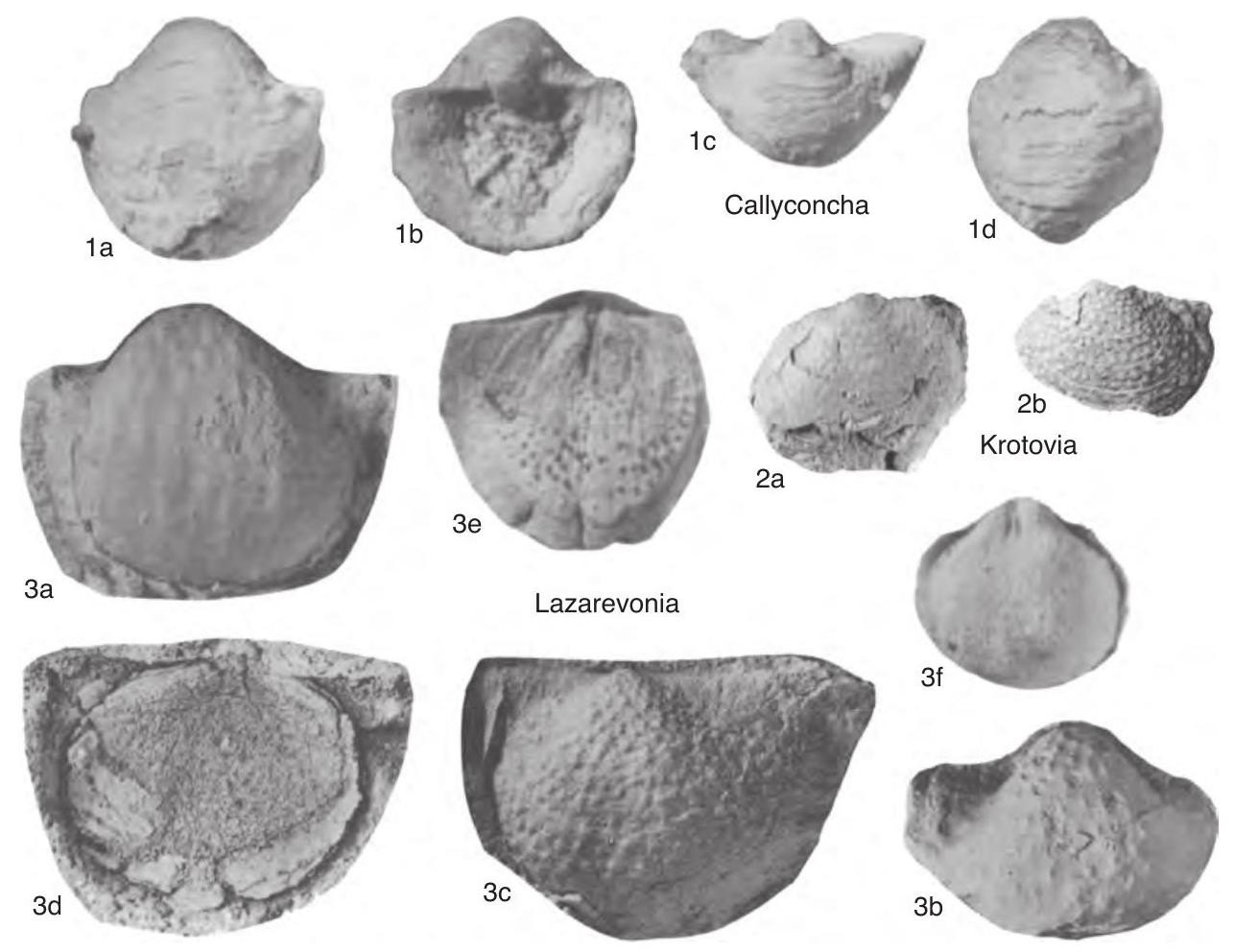
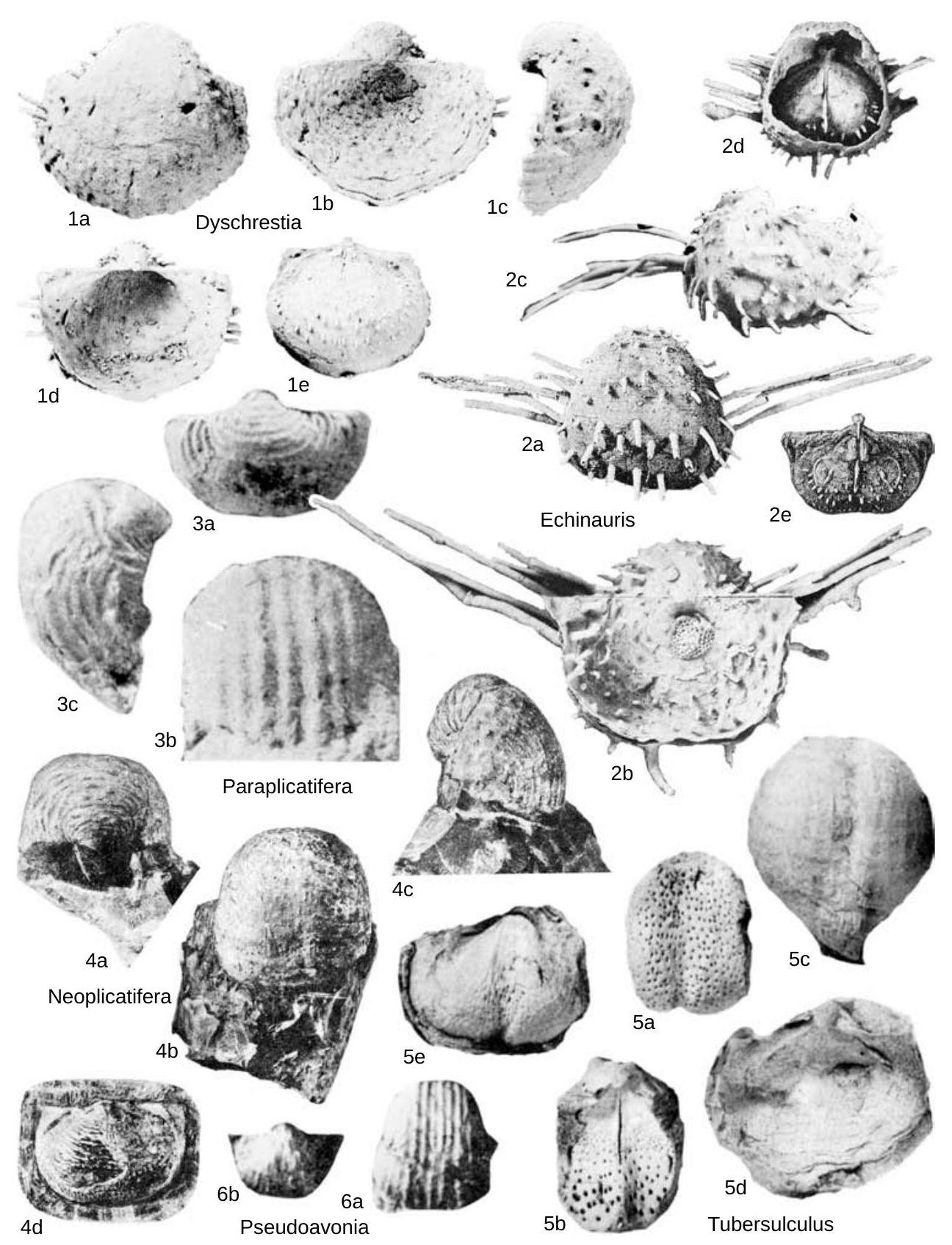 Fig. 287, 1a-e. *K. spinulosa (J. Sowerby), silicified specimens, Asbian, Fermanagh, British Isles, a-c, shell viewed ventrally, dorsally, laterally, x2.3, d, e, incomplete dorsal valve viewed posterodorsally, internally, X3.6 (Brunton, 1966). -- Fig. 1752, 2a–b. K. inflata (Shen & others), Lopingian, southern Tibet; a, holotype, incomplete ventral valve exterior, NMVP148883, ×1.5; b, dorsal valve external mold, ×1.5 (Shen & others, 2000).
Synonyms
Geographic Distribution
Eurasia, northern Africa.
Age Range
Beginning Stage in Treatise Usage:
Lower Carboniferous
Beginning International Stage:
Tournaisian
Fraction Up In Beginning Stage:
0
Beginning Date:
359.3
Ending Stage in Treatise Usage:
Upper Permian
Ending International Stage:
Changhsingian
Fraction Up In Ending Stage:
100
Ending Date:
251.9
Description
Swollen (tuberculate) spine bases, dense, quincuncially arranged spines, thin shelled, weakly developed marginal ridges, cardinal process quadrifid. [Although it is tempting to reduce the stratigraphical range of Krotovia by the introduction of Guangia in the Upper Permian, justification based on morphological reasons has yet to be made. The original diagnosis of Guangia reads as if for the type species of Krotovia, but for “dorsal spines few.” (Waterhouse, 2002b, p. 46). Shen and others (2000, p. 739) describe their K. inflata as having numerous small dorsal spines, however, and their illustration supports this. The degree to which spine bases are swollen may increase in Permian species, but this small difference does not warrant a new genus.
References
Museum or Author Information
Classification
Phylum:
Brachiopoda
Subphylum:
Rhynchonelliformea
Class:
Strophomenata
Order:
Productida
Suborder:
Productidina
Superfamily:
Productoidea
Family:
Productellidae
Subfamily:
Overtoniinae (Tribe Krotoviini)
Formal Genus Name and Reference:
Krotovia FREDERICKS, 1928, p. 779
Type Species:
Productus spinulosus J. SOWERBY, 1814 in 1812-1815, p. 155, OD
Images
(Click to enlarge in a new window)
Fig. 287, 1a-e. *K. spinulosa (J. Sowerby), silicified specimens, Asbian, Fermanagh, British Isles, a-c, shell viewed ventrally, dorsally, laterally, x2.3, d, e, incomplete dorsal valve viewed posterodorsally, internally, X3.6 (Brunton, 1966). -- Fig. 1752, 2a–b. K. inflata (Shen & others), Lopingian, southern Tibet; a, holotype, incomplete ventral valve exterior, NMVP148883, ×1.5; b, dorsal valve external mold, ×1.5 (Shen & others, 2000).
Synonyms
Geographic Distribution
Eurasia, northern Africa.
Age Range
Beginning Stage in Treatise Usage:
Lower Carboniferous
Beginning International Stage:
Tournaisian
Fraction Up In Beginning Stage:
0
Beginning Date:
359.3
Ending Stage in Treatise Usage:
Upper Permian
Ending International Stage:
Changhsingian
Fraction Up In Ending Stage:
100
Ending Date:
251.9
Description
Swollen (tuberculate) spine bases, dense, quincuncially arranged spines, thin shelled, weakly developed marginal ridges, cardinal process quadrifid. [Although it is tempting to reduce the stratigraphical range of Krotovia by the introduction of Guangia in the Upper Permian, justification based on morphological reasons has yet to be made. The original diagnosis of Guangia reads as if for the type species of Krotovia, but for “dorsal spines few.” (Waterhouse, 2002b, p. 46). Shen and others (2000, p. 739) describe their K. inflata as having numerous small dorsal spines, however, and their illustration supports this. The degree to which spine bases are swollen may increase in Permian species, but this small difference does not warrant a new genus.