
Welcome to the Brachiopod subsite on Invertebrate Paleontology!
Please enter a genera name to retrieve more information.

Lokutella
Classification
Phylum:
Brachiopoda
Subphylum:
Rhynchonelliformea
Class:
Rhynchonellata
Order:
Rhynchonellida
Superfamily:
Rhynchotetradoidea
Family:
Prionorhynchiidae
Formal Genus Name and Reference:
Lokutella VÖRÖS, 1983, p. 6
Type Species:
Rhynchonella palmaeformis HAAS, 1912, p. 232, OD
Images
(Click to enlarge in a new window)
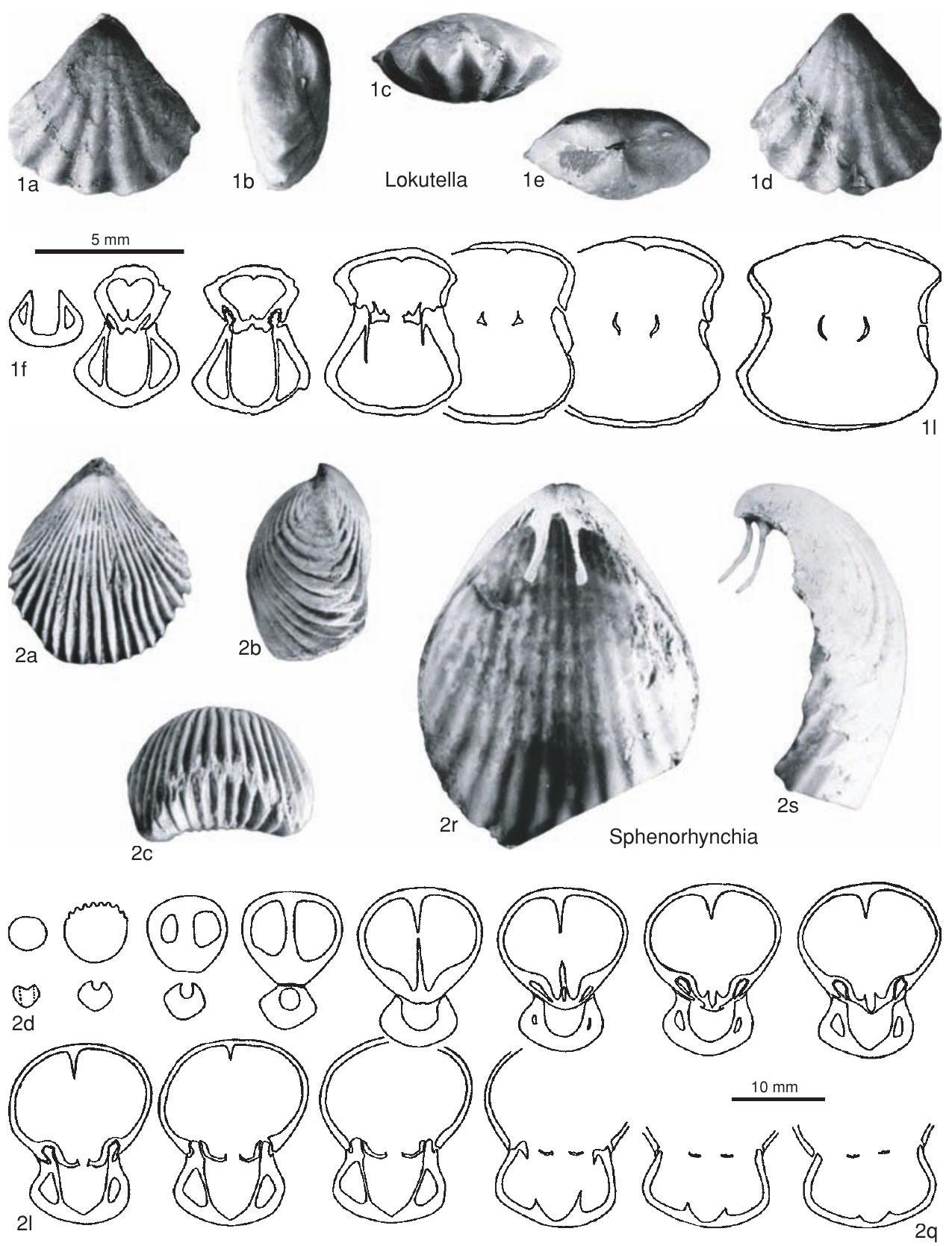 Fig. 856, 1a-l. *L. palmaeformis (Haas), Pliensbachian, Kericser, Hungary, a-e, dorsal, lateral, anterior, ventral, posterior views, HNHMB M.98.3, x1.5 (new), f-l, transverse serial sections, distances in mm from ventral umbo, 0.3 , 1.0, 1.3, 1.8, 2.4, 2.8, 3.1, HGI J. 9185 (Vörös, 1983).
Synonyms
Geographic Distribution
Sicily, Apennines, southern Alps, Hungary, ?Greece
Age Range
Beginning Stage in Treatise Usage:
Lower Jurassic (upper Sinemurian)
Beginning International Stage:
Sinemurian
Fraction Up In Beginning Stage:
50
Beginning Date:
196.18
Ending Stage in Treatise Usage:
Lower Jurassic (Pliensbachian)
Ending International Stage:
Pliensbachian
Fraction Up In Ending Stage:
100
Ending Date:
184.2
Description
Small to medium size, trigonal to securiform, nearly equibiconvex, fold and sulcus absent, anterior commissure straight but forming wide sinus, planareas well developed, generally concave, costae few, usually strong, after variable posterior smooth stage, beak small, erect to slightly incurved. Strong subparallel dental plates and crenulated teeth, dorsal median septum long but low, hinge plates fused, forming septalium, crura distally crescentic and outwardly convex.
References
Museum or Author Information
Classification
Phylum:
Brachiopoda
Subphylum:
Rhynchonelliformea
Class:
Rhynchonellata
Order:
Rhynchonellida
Superfamily:
Rhynchotetradoidea
Family:
Prionorhynchiidae
Formal Genus Name and Reference:
Lokutella VÖRÖS, 1983, p. 6
Type Species:
Rhynchonella palmaeformis HAAS, 1912, p. 232, OD
Images
(Click to enlarge in a new window)
Fig. 856, 1a-l. *L. palmaeformis (Haas), Pliensbachian, Kericser, Hungary, a-e, dorsal, lateral, anterior, ventral, posterior views, HNHMB M.98.3, x1.5 (new), f-l, transverse serial sections, distances in mm from ventral umbo, 0.3 , 1.0, 1.3, 1.8, 2.4, 2.8, 3.1, HGI J. 9185 (Vörös, 1983).
Synonyms
Geographic Distribution
Sicily, Apennines, southern Alps, Hungary, ?Greece
Age Range
Beginning Stage in Treatise Usage:
Lower Jurassic (upper Sinemurian)
Beginning International Stage:
Sinemurian
Fraction Up In Beginning Stage:
50
Beginning Date:
196.18
Ending Stage in Treatise Usage:
Lower Jurassic (Pliensbachian)
Ending International Stage:
Pliensbachian
Fraction Up In Ending Stage:
100
Ending Date:
184.2
Description
Small to medium size, trigonal to securiform, nearly equibiconvex, fold and sulcus absent, anterior commissure straight but forming wide sinus, planareas well developed, generally concave, costae few, usually strong, after variable posterior smooth stage, beak small, erect to slightly incurved. Strong subparallel dental plates and crenulated teeth, dorsal median septum long but low, hinge plates fused, forming septalium, crura distally crescentic and outwardly convex.