
Welcome to the Brachiopod subsite on Invertebrate Paleontology!
Please enter a genera name to retrieve more information.

Megerlia
Classification
Phylum:
Brachiopoda
Subphylum:
Rhynchonelliformea
Class:
Rhynchonellata
Order:
Terebratulida
Suborder:
Terebratellidina
Superfamily:
Kraussinoidea
Family:
Kraussinidae
Formal Genus Name and Reference:
Megerlia KING, 1850, p. 145
Type Species:
Anomia truncata Linnaeus, 1767, p. 1, 152, OD, not preoccupied by Megerlea ROBINEAU-DESVOIDY, 1830
Images
(Click to enlarge in a new window)
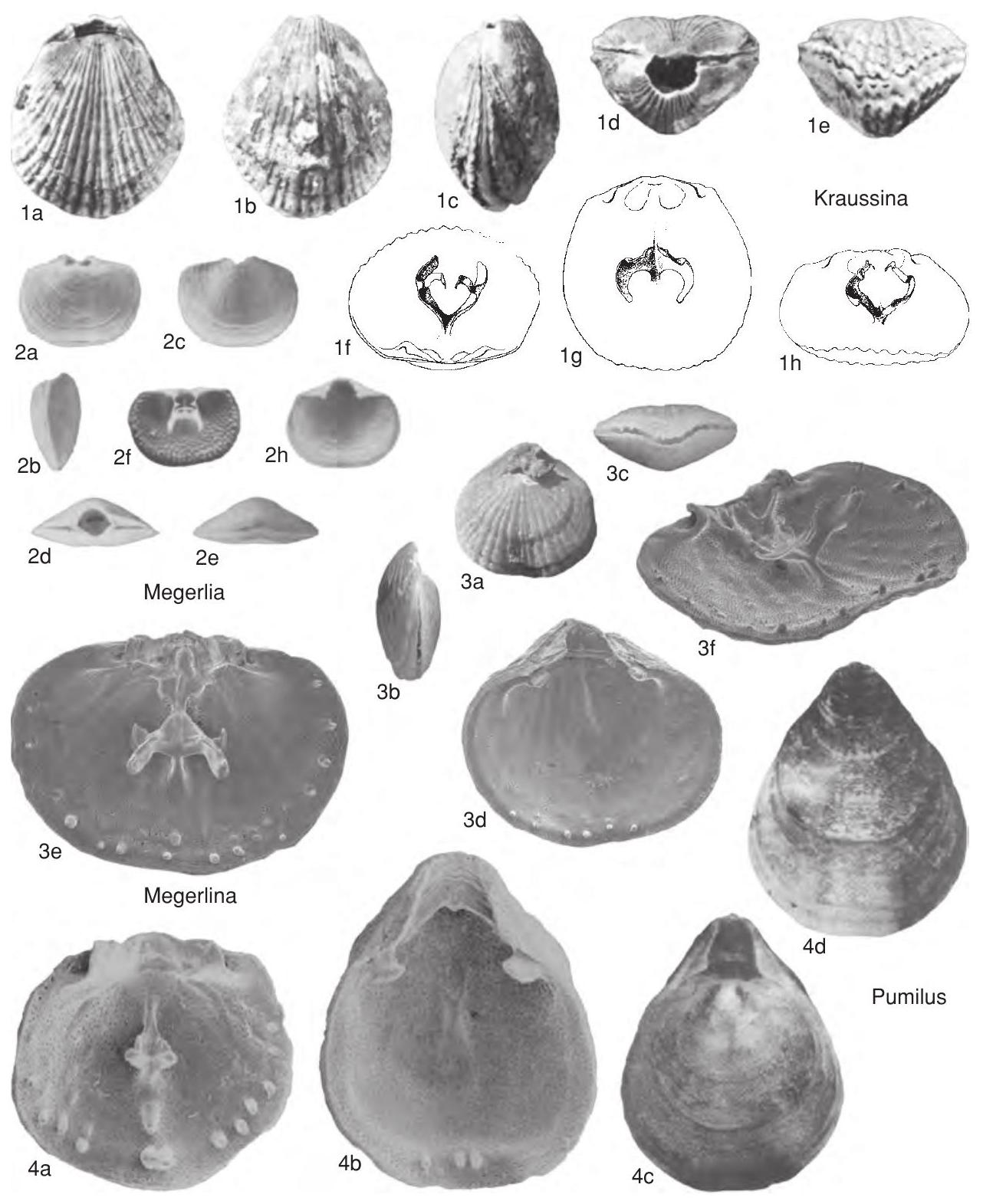 Fig. 1493, 2a-g. * M. truncata (Linnaeus), Holocene, Marseille, Mediterranean, a-e, dorsal, ventral, lateral, posterior, and anterior views, X1, f, interior of dorsal valve, g, interior of ventral valve, X1.2 (Logan, 1979).
Synonyms
Mühlfeldtia, Pantellaria
Geographic Distribution
Italy, France, Gibraltar, Algeria, Mediterranean, eastern Atlantic, Ivory Coast (121, 430 \\mathrm{~m}), off South Africa, Australia (New South Wales), Barbados, Florida Straits, Venezuela
Age Range
Beginning Stage in Treatise Usage:
Neogene (Miocene)
Beginning International Stage:
Aquitanian
Fraction Up In Beginning Stage:
0
Beginning Date:
23.04
Ending Stage in Treatise Usage:
Holocene
Ending International Stage:
Meghalayan
Fraction Up In Ending Stage:
100
Ending Date:
0
Description
Medium size, usually wider than long, biconvex to concavoconvex, anterior commissure unisulcate, capillate, striae slightly nodulose, foramen large, submesothyrid to amphithyrid, beak suberect, subtruncate, usually abraded, deltidial plates disjunct. Valve interiors radially tuberculate, ventral valve with small median septum extending under but not supporting pedicle collar. No cardinal process, crural bases attached to inner sides of widely divergent socket ridges that are excavate below, loop bifurcate with distal extensions forming complete ring, descending branches extending from cardinalia to ring, lophophore plectolophous, spicules common in mantle and arms.
References
Museum or Author Information
Classification
Phylum:
Brachiopoda
Subphylum:
Rhynchonelliformea
Class:
Rhynchonellata
Order:
Terebratulida
Suborder:
Terebratellidina
Superfamily:
Kraussinoidea
Family:
Kraussinidae
Formal Genus Name and Reference:
Megerlia KING, 1850, p. 145
Type Species:
Anomia truncata Linnaeus, 1767, p. 1, 152, OD, not preoccupied by Megerlea ROBINEAU-DESVOIDY, 1830
Images
(Click to enlarge in a new window)
Fig. 1493, 2a-g. * M. truncata (Linnaeus), Holocene, Marseille, Mediterranean, a-e, dorsal, ventral, lateral, posterior, and anterior views, X1, f, interior of dorsal valve, g, interior of ventral valve, X1.2 (Logan, 1979).
Synonyms
Mühlfeldtia, Pantellaria
Geographic Distribution
Italy, France, Gibraltar, Algeria, Mediterranean, eastern Atlantic, Ivory Coast (121, 430 \\mathrm{~m}), off South Africa, Australia (New South Wales), Barbados, Florida Straits, Venezuela
Age Range
Beginning Stage in Treatise Usage:
Neogene (Miocene)
Beginning International Stage:
Aquitanian
Fraction Up In Beginning Stage:
0
Beginning Date:
23.04
Ending Stage in Treatise Usage:
Holocene
Ending International Stage:
Meghalayan
Fraction Up In Ending Stage:
100
Ending Date:
0
Description
Medium size, usually wider than long, biconvex to concavoconvex, anterior commissure unisulcate, capillate, striae slightly nodulose, foramen large, submesothyrid to amphithyrid, beak suberect, subtruncate, usually abraded, deltidial plates disjunct. Valve interiors radially tuberculate, ventral valve with small median septum extending under but not supporting pedicle collar. No cardinal process, crural bases attached to inner sides of widely divergent socket ridges that are excavate below, loop bifurcate with distal extensions forming complete ring, descending branches extending from cardinalia to ring, lophophore plectolophous, spicules common in mantle and arms.