
Welcome to the Brachiopod subsite on Invertebrate Paleontology!
Please enter a genera name to retrieve more information.
Parathyrisina
Classification
Phylum:
Brachiopoda
Subphylum:
Rhynchonelliformea
Class:
Rhynchonellata
Order:
Athyridida
Suborder:
Athyrididina
Superfamily:
Athyridoidea
Family:
Athyrididae
Subfamily:
Athyrisininae
Formal Genus Name and Reference:
Parathyrisina Wang in Wang, Yu, & Wu, 1974, p. 41, emend., Rong & OTHERS, 2004, p. 832
Type Species:
P. bella, OD, =Athyrisina tangnae HOU, 1963, p. 416
Images
(Click to enlarge in a new window)
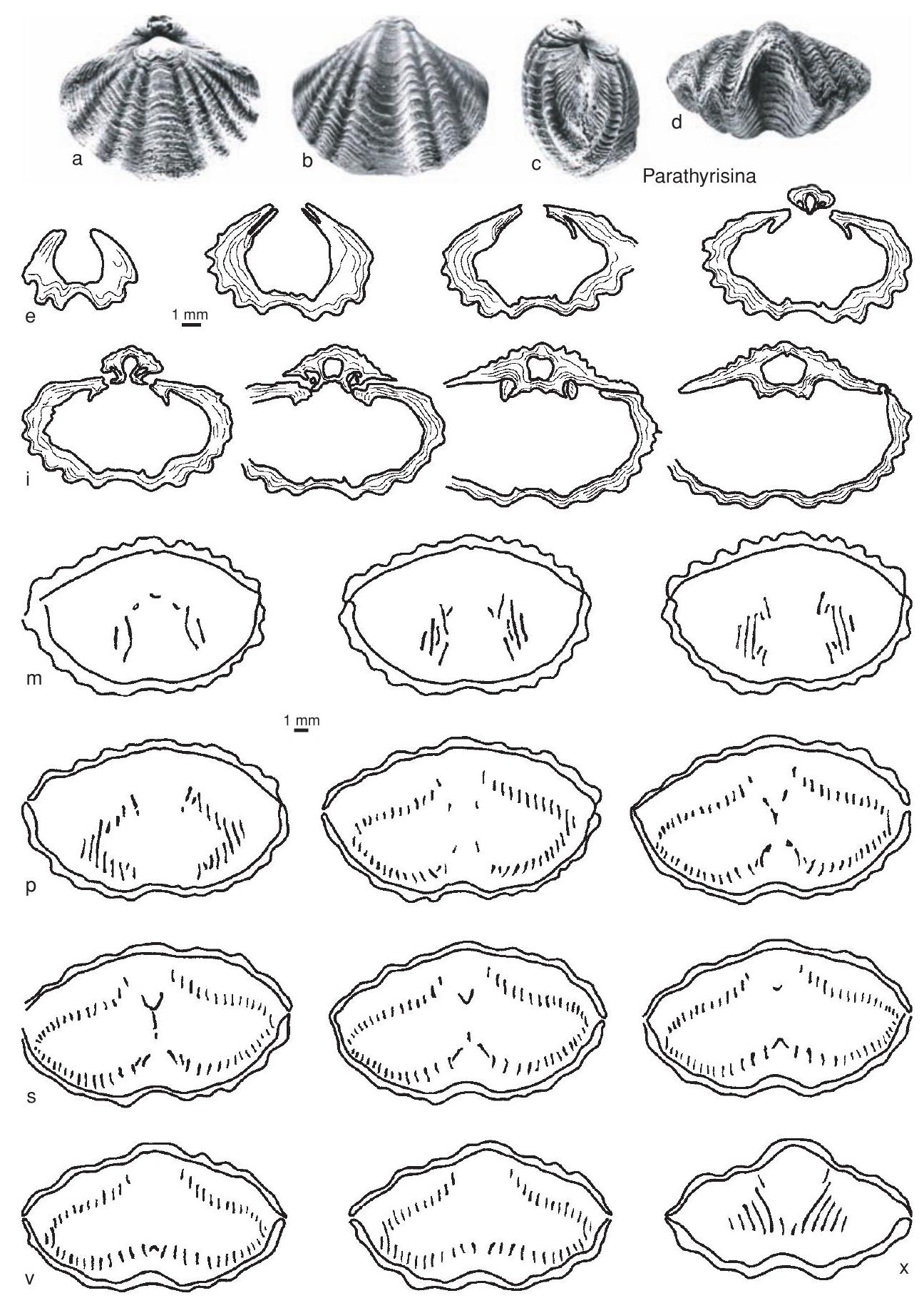 Fig. 1022a-x. * P. tangnae (Hou), Guangxi, a-d, dorsal, ventral, lateral, and anterior views, NIGP 23624, x2 (new), e-x, transverse serial sections 1.0, 2.1, 2.5, 2.9, 3.2, 3.5, 3.8, 4.3, 5.2, 5.8, 6.2, 7.25, 9.6, 10.5, 10.9, 11.3, 11.9, 12.3, 12.7, 14.5 ~mm from ventral umbo, distance from ventral umbo to first section approximate (adapted from Wang & Rong, 1986).
Synonyms
Athyrisina, Athyrisinoides, Athyrisinoidea, Neoathyrisina
Geographic Distribution
southern China (Guangxi, Sichuan), southeastern Gansu, northwestern Sichuan, western Qinling
Age Range
Beginning Stage in Treatise Usage:
Lower Devonian (upper Pragian)
Beginning International Stage:
Pragian
Fraction Up In Beginning Stage:
50
Beginning Date:
411.46
Ending Stage in Treatise Usage:
Lower Devonian (Emsian)
Ending International Stage:
Emsian
Fraction Up In Ending Stage:
100
Ending Date:
394.3
Description
Commonly small to medium, rarely large, transverse subelliptical to subcircular outline, equally to subequally biconvex shells, pedicle opening large, palintrope reduced, ventral sulcus and dorsal fold rounded, commonly well developed, without radial elements, lateral slopes bearing 3 or more costae, growth lamellae well developed, interior and jugum essentially as in Athyrisina. [This genus is distinguished from other Athyrisininae in lacking radial elements on the sulcus and fold, internally, the dental plates are long and parallel in Bruntosina but very short with very narrow lateral apical cavities, in both Athyrisina and Parathyrisina.]
References
Museum or Author Information
Classification
Phylum:
Brachiopoda
Subphylum:
Rhynchonelliformea
Class:
Rhynchonellata
Order:
Athyridida
Suborder:
Athyrididina
Superfamily:
Athyridoidea
Family:
Athyrididae
Subfamily:
Athyrisininae
Formal Genus Name and Reference:
Parathyrisina Wang in Wang, Yu, & Wu, 1974, p. 41, emend., Rong & OTHERS, 2004, p. 832
Type Species:
P. bella, OD, =Athyrisina tangnae HOU, 1963, p. 416
Images
(Click to enlarge in a new window)
Fig. 1022a-x. * P. tangnae (Hou), Guangxi, a-d, dorsal, ventral, lateral, and anterior views, NIGP 23624, x2 (new), e-x, transverse serial sections 1.0, 2.1, 2.5, 2.9, 3.2, 3.5, 3.8, 4.3, 5.2, 5.8, 6.2, 7.25, 9.6, 10.5, 10.9, 11.3, 11.9, 12.3, 12.7, 14.5 ~mm from ventral umbo, distance from ventral umbo to first section approximate (adapted from Wang & Rong, 1986).
Synonyms
Athyrisina, Athyrisinoides, Athyrisinoidea, Neoathyrisina
Geographic Distribution
southern China (Guangxi, Sichuan), southeastern Gansu, northwestern Sichuan, western Qinling
Age Range
Beginning Stage in Treatise Usage:
Lower Devonian (upper Pragian)
Beginning International Stage:
Pragian
Fraction Up In Beginning Stage:
50
Beginning Date:
411.46
Ending Stage in Treatise Usage:
Lower Devonian (Emsian)
Ending International Stage:
Emsian
Fraction Up In Ending Stage:
100
Ending Date:
394.3
Description
Commonly small to medium, rarely large, transverse subelliptical to subcircular outline, equally to subequally biconvex shells, pedicle opening large, palintrope reduced, ventral sulcus and dorsal fold rounded, commonly well developed, without radial elements, lateral slopes bearing 3 or more costae, growth lamellae well developed, interior and jugum essentially as in Athyrisina. [This genus is distinguished from other Athyrisininae in lacking radial elements on the sulcus and fold, internally, the dental plates are long and parallel in Bruntosina but very short with very narrow lateral apical cavities, in both Athyrisina and Parathyrisina.]