
Welcome to the Brachiopod subsite on Invertebrate Paleontology!
Please enter a genera name to retrieve more information.

Prionorhynchia
Classification
Phylum:
Brachiopoda
Subphylum:
Rhynchonelliformea
Class:
Rhynchonellata
Order:
Rhynchonellida
Superfamily:
Rhynchotetradoidea
Family:
Prionorhynchiidae
Formal Genus Name and Reference:
Prionorhynchia BUCKMAN, 1918, p. 62
Type Species:
Terebratula serrata J. de C. SOWERBY, 1825 in 1823-1825, p. 168, OD
Images
(Click to enlarge in a new window)
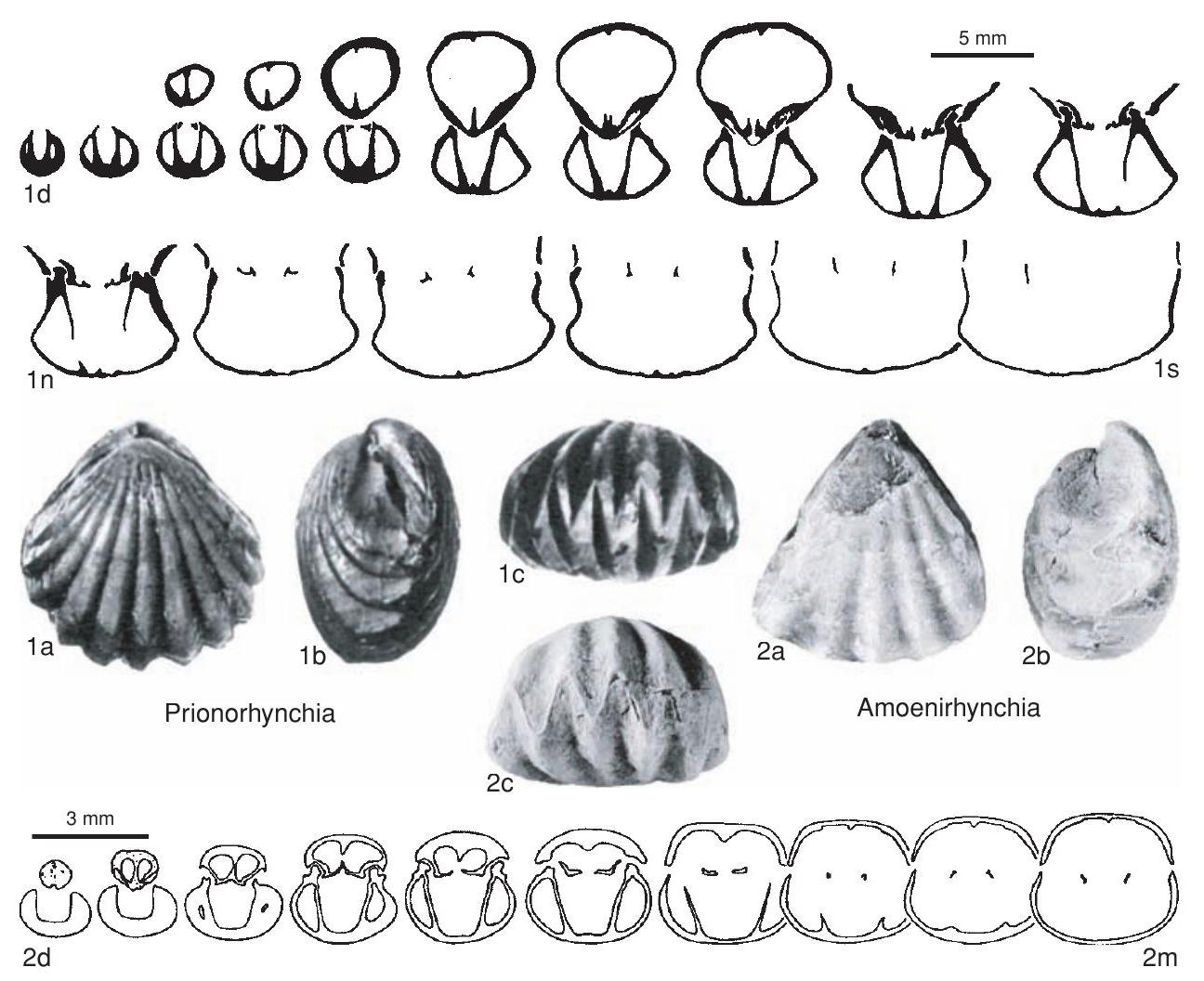 Fig. 855, 1a-s. *P. serrata (J. de C. Sowerby), upper Pliensbachian, Dorset, England, a-c, holotype, dorsal, lateral, anterior views, BMNH B.61517, x1, d- s, transverse serial sections, distances in mm from ventral umbo, 0.4, 0.6, 0.9, 1.0, 1.1, 1.6, 1.8, 2.0, 2.3, 2.6, 2.9, 3.5, 4.1, 4.3, 4.7, 5.3, BMNH B. 33333 (Ager, 1956).
Synonyms
Geographic Distribution
England, France, Germany, Austria, Italy, Spain, Switzerland, Slovakia, Hungary, Yugoslavia, Greece, Bulgaria, Morocco, Algeria, Anatolia, Caucasus, Thailand, Indonesia (Seran, ?Timor), Argentina, ?New Zealand
Age Range
Beginning Stage in Treatise Usage:
Lower Jurassic (?Hettangian, Sinemurian)
Beginning International Stage:
Hettangian
Fraction Up In Beginning Stage:
0
Beginning Date:
201.36
Ending Stage in Treatise Usage:
Middle Jurassic (Aalenian)
Ending International Stage:
Aalenian
Fraction Up In Ending Stage:
100
Ending Date:
170.9
Description
Medium size to large, subtrigonal to subpentagonal, depressed equibiconvex to globose dorsibiconvex, without interarea but planareas well developed, rectimarginate or uniplicate, costae strong, sharp, beak very small, somewhat incurved, deltidial plates narrow, thick. Dental plates thin, ventrally convergent to subparallel, often with low apical ventral median ridge in between, dorsal median septum very short, septalium small, pitlike, hinge teeth may be crenulated, crura raduliform to possibly incipiently canaliform.
References
Museum or Author Information
Classification
Phylum:
Brachiopoda
Subphylum:
Rhynchonelliformea
Class:
Rhynchonellata
Order:
Rhynchonellida
Superfamily:
Rhynchotetradoidea
Family:
Prionorhynchiidae
Formal Genus Name and Reference:
Prionorhynchia BUCKMAN, 1918, p. 62
Type Species:
Terebratula serrata J. de C. SOWERBY, 1825 in 1823-1825, p. 168, OD
Images
(Click to enlarge in a new window)
Fig. 855, 1a-s. *P. serrata (J. de C. Sowerby), upper Pliensbachian, Dorset, England, a-c, holotype, dorsal, lateral, anterior views, BMNH B.61517, x1, d- s, transverse serial sections, distances in mm from ventral umbo, 0.4, 0.6, 0.9, 1.0, 1.1, 1.6, 1.8, 2.0, 2.3, 2.6, 2.9, 3.5, 4.1, 4.3, 4.7, 5.3, BMNH B. 33333 (Ager, 1956).
Synonyms
Geographic Distribution
England, France, Germany, Austria, Italy, Spain, Switzerland, Slovakia, Hungary, Yugoslavia, Greece, Bulgaria, Morocco, Algeria, Anatolia, Caucasus, Thailand, Indonesia (Seran, ?Timor), Argentina, ?New Zealand
Age Range
Beginning Stage in Treatise Usage:
Lower Jurassic (?Hettangian, Sinemurian)
Beginning International Stage:
Hettangian
Fraction Up In Beginning Stage:
0
Beginning Date:
201.36
Ending Stage in Treatise Usage:
Middle Jurassic (Aalenian)
Ending International Stage:
Aalenian
Fraction Up In Ending Stage:
100
Ending Date:
170.9
Description
Medium size to large, subtrigonal to subpentagonal, depressed equibiconvex to globose dorsibiconvex, without interarea but planareas well developed, rectimarginate or uniplicate, costae strong, sharp, beak very small, somewhat incurved, deltidial plates narrow, thick. Dental plates thin, ventrally convergent to subparallel, often with low apical ventral median ridge in between, dorsal median septum very short, septalium small, pitlike, hinge teeth may be crenulated, crura raduliform to possibly incipiently canaliform.