
Welcome to the Brachiopod subsite on Invertebrate Paleontology!
Please enter a genera name to retrieve more information.
Rugitela
Classification
Phylum:
Brachiopoda
Subphylum:
Rhynchonelliformea
Class:
Rhynchonellata
Order:
Terebratulida
Suborder:
Terebratellidina
Superfamily:
Zeillerioidea
Family:
Zeilieriidae
Subfamily:
Zeilieriinae
Formal Genus Name and Reference:
Rugitela Muir-Wood, 1936, p. 121
Type Species:
Terebratula bullata J. de. C. SOWERBY, 1823 in 1823-1825, p. 49, OD
Images
(Click to enlarge in a new window)
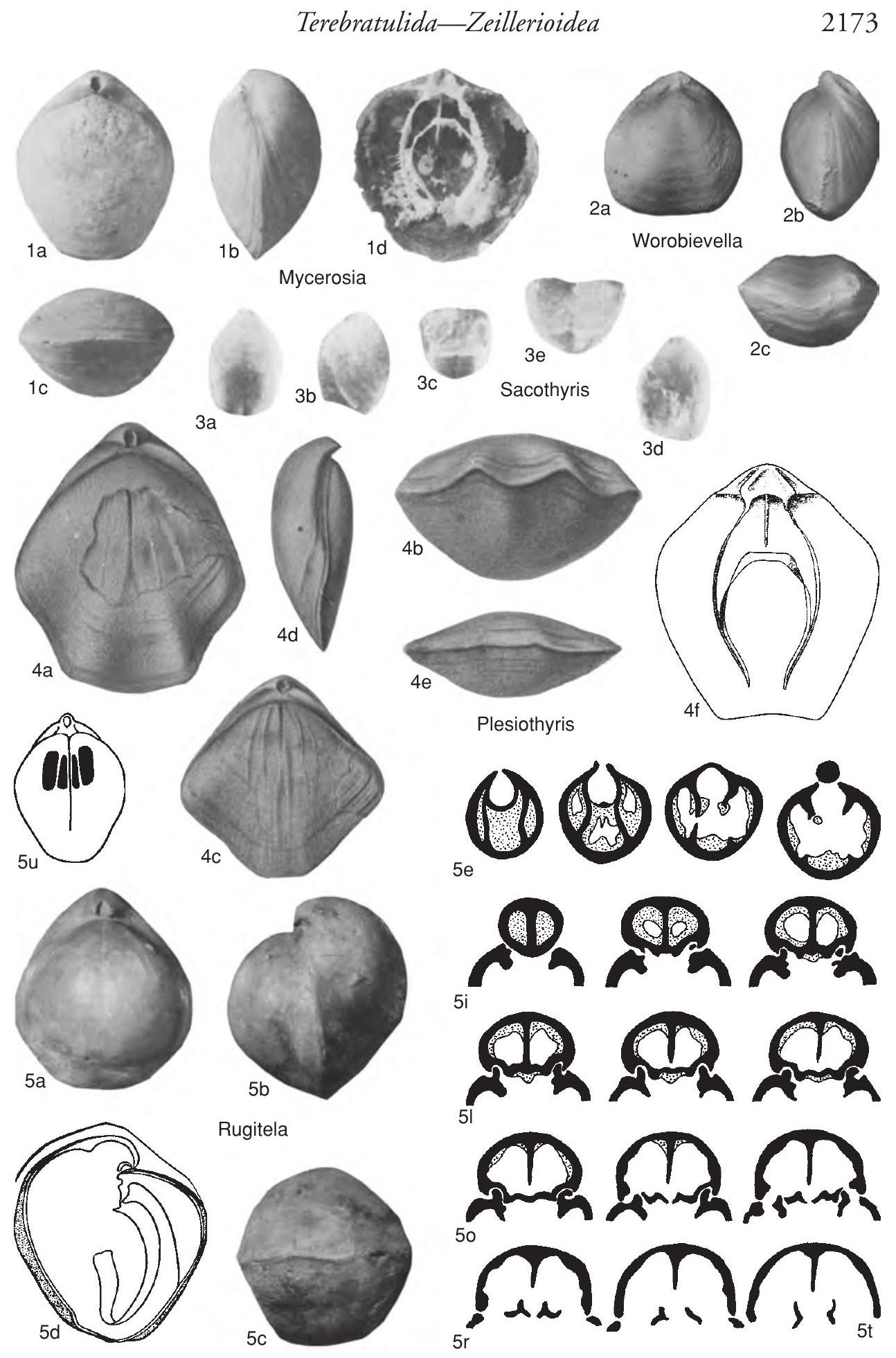 Fig. 1444, 5a-t. *R. bullata (J. de C. Sowerby), Bathonian, Fullers Earth Rock, Frome, southern England, a-c, dorsal, lateral, anterior views, d, longitudinal section showing loop, X1.3 (Muir-Wood, 1965b), e-t, serial transverse sections, 0.4, 2.5, 2.7, 2.9, 3.9, 4.2, 4.3, 4.5, 4.9, 5.1, 5.2, 5.3, 5.6, 5.8, 6.1, 6.5 ~mm from umbo, X1.2 (adapted from Muir-Wood, 1936).——Fig. 1444, 5u. R. cadomensis (Eudes-Deslongchamps), Fullers Earth Rock, Bath, southern England, dorsal valve interior mold, showing median septum and adductor muscle scars, X0.7 (Muir-Wood, 1965b).
Synonyms
Russiella
Geographic Distribution
England, France, Saudi Ababia, Toarcian
Age Range
Beginning Stage in Treatise Usage:
Lower Jurassic (Toarcian)
Beginning International Stage:
Toarcian
Fraction Up In Beginning Stage:
0
Beginning Date:
184.2
Ending Stage in Treatise Usage:
Middle Jurassic (Bathonian), Lower Cretaceous (?Berriasian?, Hauterivian)
Ending International Stage:
Hauterivian
Fraction Up In Ending Stage:
100
Ending Date:
126.5
Description
Medium size, elongate-oval to bilobate in outline, sulcocarinate in early stages, becoming biconvex, commonly globose, anterior commissure rectimarginate, lobate, umbo suberect to incurved, with short, subangular beak ridges, pedicle foramen mesothyrid or permesothyrid, telate, shell surface with concentric rugae, pedicle collar rarely observed, dental plates angled, thickened by callus, septalium replaced by callus ridge anteriorly, inner socket ridges, hinge plates, and median callosity forming W-shaped structure, median septum long, high, bladelike or acutely triangular in cross section, extending 0.7 valve length, supporting posterior half of crural plates only, structures thickened by umbonal callus, loop possibly without spines, dorsal adductor scars elongate-oval.
References
Museum or Author Information
Classification
Phylum:
Brachiopoda
Subphylum:
Rhynchonelliformea
Class:
Rhynchonellata
Order:
Terebratulida
Suborder:
Terebratellidina
Superfamily:
Zeillerioidea
Family:
Zeilieriidae
Subfamily:
Zeilieriinae
Formal Genus Name and Reference:
Rugitela Muir-Wood, 1936, p. 121
Type Species:
Terebratula bullata J. de. C. SOWERBY, 1823 in 1823-1825, p. 49, OD
Images
(Click to enlarge in a new window)
Fig. 1444, 5a-t. *R. bullata (J. de C. Sowerby), Bathonian, Fullers Earth Rock, Frome, southern England, a-c, dorsal, lateral, anterior views, d, longitudinal section showing loop, X1.3 (Muir-Wood, 1965b), e-t, serial transverse sections, 0.4, 2.5, 2.7, 2.9, 3.9, 4.2, 4.3, 4.5, 4.9, 5.1, 5.2, 5.3, 5.6, 5.8, 6.1, 6.5 ~mm from umbo, X1.2 (adapted from Muir-Wood, 1936).——Fig. 1444, 5u. R. cadomensis (Eudes-Deslongchamps), Fullers Earth Rock, Bath, southern England, dorsal valve interior mold, showing median septum and adductor muscle scars, X0.7 (Muir-Wood, 1965b).
Synonyms
Russiella
Geographic Distribution
England, France, Saudi Ababia, Toarcian
Age Range
Beginning Stage in Treatise Usage:
Lower Jurassic (Toarcian)
Beginning International Stage:
Toarcian
Fraction Up In Beginning Stage:
0
Beginning Date:
184.2
Ending Stage in Treatise Usage:
Middle Jurassic (Bathonian), Lower Cretaceous (?Berriasian?, Hauterivian)
Ending International Stage:
Hauterivian
Fraction Up In Ending Stage:
100
Ending Date:
126.5
Description
Medium size, elongate-oval to bilobate in outline, sulcocarinate in early stages, becoming biconvex, commonly globose, anterior commissure rectimarginate, lobate, umbo suberect to incurved, with short, subangular beak ridges, pedicle foramen mesothyrid or permesothyrid, telate, shell surface with concentric rugae, pedicle collar rarely observed, dental plates angled, thickened by callus, septalium replaced by callus ridge anteriorly, inner socket ridges, hinge plates, and median callosity forming W-shaped structure, median septum long, high, bladelike or acutely triangular in cross section, extending 0.7 valve length, supporting posterior half of crural plates only, structures thickened by umbonal callus, loop possibly without spines, dorsal adductor scars elongate-oval.