
Welcome to the Brachiopod subsite on Invertebrate Paleontology!
Please enter a genera name to retrieve more information.
Sellithyris
Classification
Phylum:
Brachiopoda
Subphylum:
Rhynchonelliformea
Class:
Rhynchonellata
Order:
Terebratulida
Suborder:
Terebratulidina
Superfamily:
Terebratuloidea
Family:
Sellithyrididae
Subfamily:
Sellithyridinae
Formal Genus Name and Reference:
Sellithyris MIDDLEMISS, 1959, p. 113
Type Species:
Terebratula sella J. de C. SOWERBY, 1823 in 1823-1825, p. 53, OD
Images
(Click to enlarge in a new window)
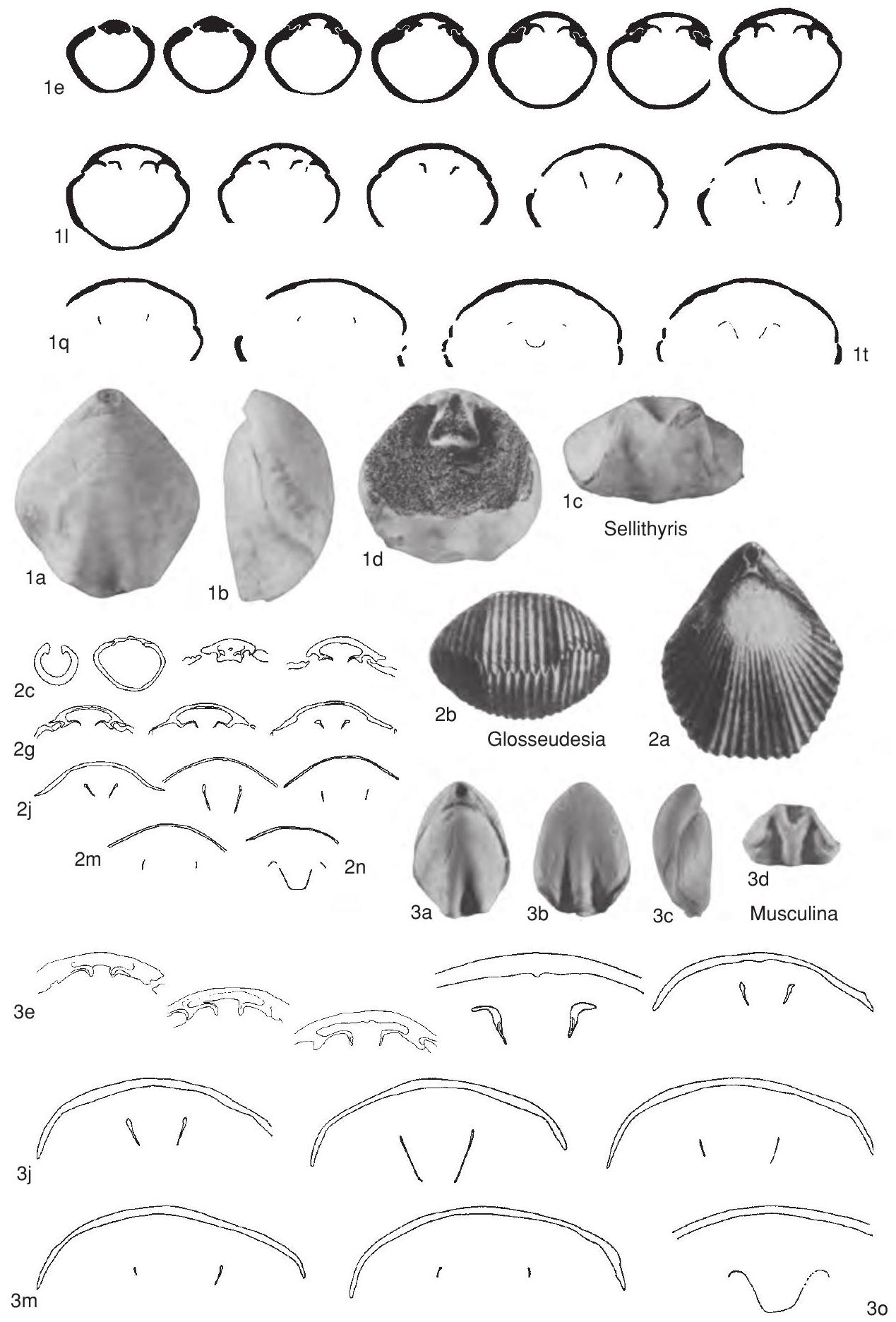 Fig. 1363, 1a-t. *S. sella (J. DE C. Sowerby), Aptian, Isle of Wight, England, a-c, dorsal, lateral, and anterior views, ×1, d, dorsal valve interior, ×1 (Cooper, 1983), e-t, serial transverse sections 3.6, 3.8, 4.2, 4.6, 5.0, 5.2, 5.4, 5.5, 5.6, 6.0, 6.8, 7.4, 8.0, 9.2, 9.8, 10.0 mm from ventral umbo, ×1 (Middlemiss, 1959).
Synonyms
Geographic Distribution
Ukraine, Kazakstan, Caucasus, Georgia, Mexico, England, France, Belgium, Germany, Spain, Switzerland, Sardinia, Egypt, Turkmenia, Tibet
Age Range
Beginning Stage in Treatise Usage:
Cretaceous (Berriasian
Beginning International Stage:
Berriasian
Fraction Up In Beginning Stage:
0
Beginning Date:
143.1
Ending Stage in Treatise Usage:
Cretaceous (Turonian)
Ending International Stage:
Turonian
Fraction Up In Ending Stage:
100
Ending Date:
89.39
Description
Small to medium, subpentagonal in outline, anterior commissure strongly sulciplicate, shell may be faintly capillate, beak short, erect, foramen large, marginate, mesothyrid to permesothyrid, cardinal process semiellipse, outer hinge plates wide, concave, forming deep, U-shaped troughs between socket ridges and crural bases, no inner hinge plates, loop wide, triangular, transverse band narrow, strongly arched and protuberant.
References
Museum or Author Information
Classification
Phylum:
Brachiopoda
Subphylum:
Rhynchonelliformea
Class:
Rhynchonellata
Order:
Terebratulida
Suborder:
Terebratulidina
Superfamily:
Terebratuloidea
Family:
Sellithyrididae
Subfamily:
Sellithyridinae
Formal Genus Name and Reference:
Sellithyris MIDDLEMISS, 1959, p. 113
Type Species:
Terebratula sella J. de C. SOWERBY, 1823 in 1823-1825, p. 53, OD
Images
(Click to enlarge in a new window)
Fig. 1363, 1a-t. *S. sella (J. DE C. Sowerby), Aptian, Isle of Wight, England, a-c, dorsal, lateral, and anterior views, ×1, d, dorsal valve interior, ×1 (Cooper, 1983), e-t, serial transverse sections 3.6, 3.8, 4.2, 4.6, 5.0, 5.2, 5.4, 5.5, 5.6, 6.0, 6.8, 7.4, 8.0, 9.2, 9.8, 10.0 mm from ventral umbo, ×1 (Middlemiss, 1959).
Synonyms
Geographic Distribution
Ukraine, Kazakstan, Caucasus, Georgia, Mexico, England, France, Belgium, Germany, Spain, Switzerland, Sardinia, Egypt, Turkmenia, Tibet
Age Range
Beginning Stage in Treatise Usage:
Cretaceous (Berriasian
Beginning International Stage:
Berriasian
Fraction Up In Beginning Stage:
0
Beginning Date:
143.1
Ending Stage in Treatise Usage:
Cretaceous (Turonian)
Ending International Stage:
Turonian
Fraction Up In Ending Stage:
100
Ending Date:
89.39
Description
Small to medium, subpentagonal in outline, anterior commissure strongly sulciplicate, shell may be faintly capillate, beak short, erect, foramen large, marginate, mesothyrid to permesothyrid, cardinal process semiellipse, outer hinge plates wide, concave, forming deep, U-shaped troughs between socket ridges and crural bases, no inner hinge plates, loop wide, triangular, transverse band narrow, strongly arched and protuberant.